
If your website has lost visitors and you’re facing a Google core update traffic drop, the instinct is to start rewriting pages. That is usually the wrong move. Before any changes are made, the actual cause of the drop needs to be identified correctly: did your search rankings fall, did fewer people click even though your rankings held, did Google decide your page no longer matches what searchers want, did a technical problem coincide with the update, or does your overall website simply look less credible than your competitors?
Recovery only begins when the response matches the actual problem, not when edits start.
I have seen this pattern across enough post-update reviews to know that early rewrites usually create more confusion than clarity.
If someone on your team is searching for steps to recover from a Google core update, this is the right starting point. Most businesses do not recover because they start changing their website before understanding what the data is actually telling them.
Key Takeaways
• A Google core update traffic drop is usually a re-evaluation, not a penalty.
• Before making changes, identify whether the loss is caused by rankings, click-through rate, search intent, technical issues, or site-wide trust signals.
• Most failed recoveries happen because businesses start rewriting content before diagnosing the real problem.
• Recovery improves when the fix matches the specific failure mode.
Not sure which of these applies to your site?
A Manual SEO Audit identifies the exact failure mode that’s affecting rankings, CTR, intent mismatch, or trust, before you touch a single page.
What a core update traffic drop actually means
A core update traffic drop usually means Google has reassessed your pages against competing results and decided other pages are now a better fit for the search. Google did not flag your site or take manual action against it. Google itself explains that core updates are broad improvements to how search results are assessed, rather than actions targeting individual websites.
What happened is closer to this: Google re-evaluated your pages against every competing page that targets the same audience, and decided that other results now serve that audience better.
That distinction matters enormously. If you treat it as a penalty, you look backward and hunt for something you did wrong. If you treat it as a competitive re-evaluation, you look outward and ask what the businesses now outranking you are doing better.
Three situations commonly describe what has happened when a site loses traffic after a core update:
- Your search rankings fell and, as a result, fewer visitors arrived.
- Your rankings stayed roughly where they were, but fewer people chose to click your result. (This is called a CTR loss: CTR means Click-Through Rate, the percentage of searchers who actually click your listing.)
- Only certain sections of your website, or certain topics, lost visibility, not the whole site.
These are not variations of the same problem. A page that fell from the third search result to the eleventh has a different problem than a page that stayed in third position but stopped attracting clicks because Google changed what else appears on that page around it. Treating them the same way wastes time and money.
There is a second reason this needs careful handling. Business owners often hear several concepts mentioned together in the same conversation: the Helpful Content System, E-E-A-T, Google’s Quality Rater Guidelines, Search Intent. These are all real and connected, but they do not all point to the same diagnosis or the same fix. Treating them as one explanation is where most recovery decisions go wrong.
If the traffic drop was sudden and happened outside of a confirmed Google update window, the supporting article My Website Traffic Dropped Overnight: What Should I Check First? is the right place to start before assuming a core update is involved.
Why most recovery advice fails
Most recovery advice fails because it skips diagnosis and moves straight to content changes.
The standard recovery advice follows a predictable pattern: find the date of the update, compare your traffic in Google’s analytics tools before and after, improve your content quality, and wait. That advice is not wrong. It is just incomplete, and incomplete advice leads to wasted effort.
Here is the contrarian view, and it is important: the update did not cause your traffic drop in the straightforward way most articles suggest. In most cases, the update revealed weaknesses that already existed. Competing websites became a stronger match for your audience, and Google updated its rankings to reflect that.
This changes everything about how you should respond. Hunting for what went wrong on your site is less useful than understanding what the sites now outranking you are doing right.
Two observations make this easier to understand:
- One 2026 analysis found that 70% of pages losing rankings during a core update lost because competing pages improved, not because the losing page got worse.
- Material surfaced during the Google DOJ antitrust trial also suggests that site-level quality signals may be more domain-based and more stable than many page-level recovery guides assume.
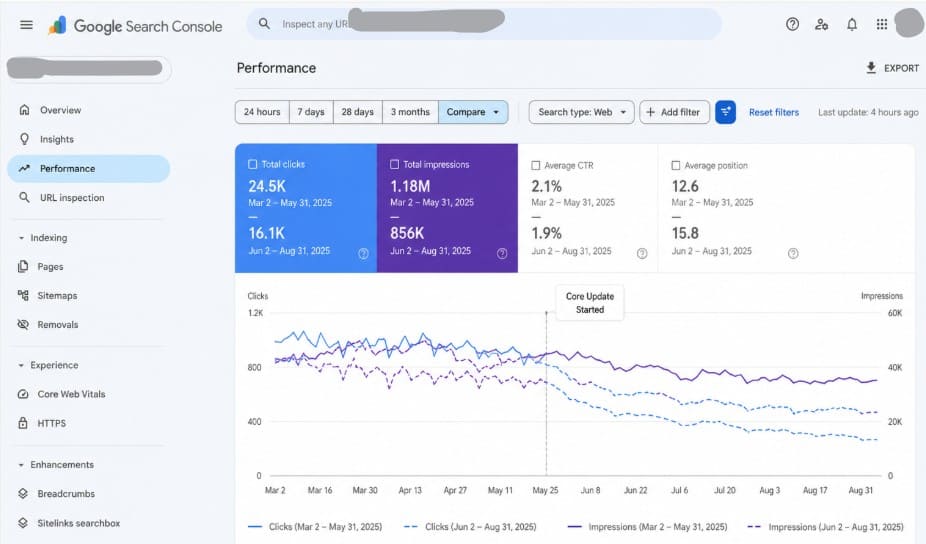
For example, a service page that lost 60% of its traffic after an update rarely recovers all at once. More often, impressions stabilize first, rankings stop falling, and click-through rates improve before overall traffic starts to return.
In practice, I rarely see businesses fail because they waited too long. I far more often see them fail because they started rewriting pages before understanding what actually changed.
Content quality still matters. But page-level edits are often a downstream fix for an upstream problem: your website does not demonstrate enough authority on the topic, your content does not prove real-world experience, competing sites look more trustworthy overall, or multiple pages on your site are competing against each other for the same audience.
The broader diagnostic framework for this topic is covered in Organic Traffic Drop Checklist (2026): The 5-Layer Diagnosis Most SEOs Skip. This article stays focused specifically on the core update branch of that larger problem.
The Google Core Update Traffic Drop Triage Framework
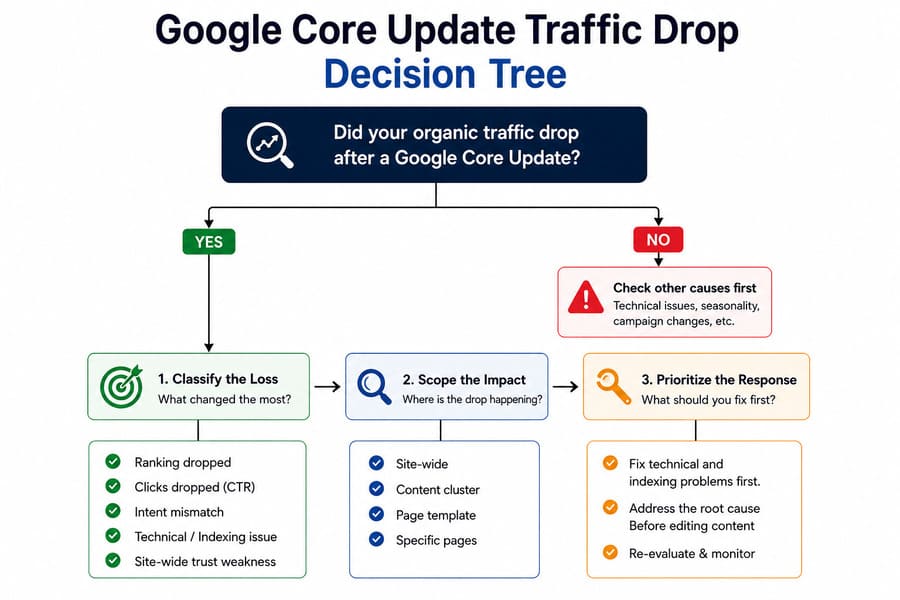
Recovery becomes significantly simpler when you stop asking one large, vague question: “why did our traffic drop?” and replace it with three smaller, structured ones: what type of loss is this, how widely does it affect the site, and what should be addressed first?
Most recovery guides explain what causes core update drops but do not give you a decision sequence. That gap is what this framework fills.
Start with Layer 1: Classify the loss.
- Ranking loss: Your pages have fallen down the search results and are no longer competitive. Fewer visitors are arriving because you are harder to find. Think of it like losing shelf space in a retail store.
- CTR loss: Your search position stayed similar, but fewer people are clicking your result. This happens when Google changes what else appears on the page: AI-generated answer boxes, competitor ads, other results and your listing gets less attention as a result. Your position stayed; the environment around it changed.
- Intent mismatch: Google has decided that searchers asking your target question now want a fundamentally different type of answer than your page provides. For example, someone searching “how to reduce business insurance costs” may now get a comparison tool or a broker directory instead of an article. Your article did not get worse; Google’s preferred answer type changed.
- Technical or indexing disruption: The timing of the update may be a coincidence. The real cause may be a technical problem: your pages are not loading correctly, Google cannot read them properly, or the wrong version of a page is being indexed. These problems can suppress traffic entirely and have nothing to do with content quality.
- Site-level trust weakness: The loss is spread across multiple sections of your site, not isolated to one topic. Google appears to view your overall domain as less credible or less authoritative than your competitors, similar to how a new supplier with no track record loses business to an established one even when their product is comparable.
Then move to Layer 2: Scope the impact.
- Sitewide, almost everything dropped.
- One page template, for example, all your product pages or all your blog posts.
- One content cluster, a specific topic or service area on your site.
- One topic or subject matter area.
- A small group of pages all targeting a similar audience need.
This matters because the response to a sitewide credibility problem is completely different from the response to a single topic cluster falling out of alignment. Applying the same fix to both is how businesses waste months of effort.
Finally, use Layer 3: Prioritize the response.
- Address any technical problems first. These are the highest-confidence fixes.
- Study the pages currently outranking you. Look at their format, depth, evidence, and the specific need they address.
- Identify pages on your own site that are competing against each other for the same audience. This undermines your own rankings.
- Strengthen credibility and trust signals where your whole site appears thin or generic compared to competitors.
- Hold off on major rewrites until the specific failure mode is clear.
Classifying this yourself takes time, and Search Console fluency most business owners don’t have day-to-day. A Manual SEO Audit does this classification for your site directly.
The core rule: do not change your content until you know whether the loss is ranking-led, click-led, intent-led, technical, or trust-led. Changing the wrong thing first almost always delays recovery.
If your rankings did not really move but your traffic fell, the more targeted resource is Your Traffic Dropped But Your Rankings Didn’t, Here’s What’s Actually Wrong. That belongs to the click-rate branch, not the rankings branch.
How to diagnose what the core update affected on your site
The right place to start is Google Search Console, Google’s free dashboard that shows how your site performs in search results. Not your website’s CMS (content management system, the platform you use to publish pages). Not a third-party tool. The raw data from Google itself.
The first question is whether the loss sits in pages, queries, or clusters.
- If specific pages lost traffic and the search terms those pages target also lost position, you are looking at a rankings problem.
- If clicks dropped more than your visibility did and your average position stayed fairly stable, the issue is likely a click-rate problem. Your result is being shown but fewer people are choosing it.
- If only one topic area or section of your site dropped, study the pages now outranking that cluster carefully before touching anything else on the site.
The second question is whether Google’s search results page itself changed, regardless of what happened to your rankings.
A page can remain entirely sound and still lose visitors if the top results now emphasize a different type of answer. For example, a search that used to reward detailed blog posts may now favor comparison pages, calculators, discussion forums, or first-hand case studies. The content itself may still be accurate, but Google now believes users want a different type of answer.
In some cases, the question people are typing into Google has not changed at all, but Google’s preferred answer format has shifted. A practical checklist article may now be outranked by a forum discussion. A general overview may be replaced by a detailed case study from someone with direct experience. A thin summary may lose ground to a page that clearly demonstrates who wrote it, what their experience is, and why their answer should be trusted.
This is also where Google’s quality concepts become relevant to your diagnosis:
- Google Search Console (the free dashboard) isolates where the loss occurred, which pages, which search terms, which time period.
- Search Intent: what Google believes the searcher actually wants, explains why a replacement page may be outranking you even if yours appears more thorough.
- E-E-A-T (Experience, Expertise, Authoritativeness, Trustworthiness): Google’s framework for evaluating whether a page deserves trust, and it helps identify what credibility signals your content may be missing.
- Helpful Content System: Google’s sitewide assessment of whether your website primarily exists to genuinely help people or primarily to rank in search results.
- Google Search Quality Rater Guidelines: the internal document Google uses to train human evaluators who assess search quality, gives the clearest language for understanding what “trustworthy” and “experienced” mean in Google’s evaluation.
A practical checklist for comparing your pages against the current winners:
- What type of page is ranking now: article, tool, forum, case study or a product page?
- How specifically does it address the searcher’s question?
- Does it demonstrate real, first-hand experience or original research?
- Is it clear who wrote it and why they are qualified?
- Does it answer the question more directly than yours?
- Does the page and the site it belongs to appear more credible overall?
The answer to “how do I check what the core update affected on my site” is this: identify the pattern of the loss first, then compare that pattern against what the current winners look like. That process is more useful than running through a generic list of fixes.
This section stops at diagnostic logic deliberately. The exact steps for filtering and grouping data in Google Search Console vary too much by site structure to publish as a universal recipe. The framework holds; the exact configuration is site-specific.
If your rankings stayed flat but traffic fell, use Traffic Dropped But Rankings Are the Same? Real Reasons Explained. If your pages are appearing in search results but generating almost no clicks, Impressions in Google But No Clicks is the right resource for that specific situation.
What real recovery patterns look like after a core update
The framework above describes how to classify and prioritize the problem. What follows is what that process looks like when applied to real sites.
The most consistent finding across actual recovery work is that sites hit in the same update rollout rarely share the same root cause. This is why blanket fixes “rewrite everything,” “improve all content quality,” “add more expertise signals” are so often ineffective. The rollout hit many sites; each site’s underlying problem is different.
Business owners consistently overestimate how much their content has declined and underestimate how weak their diagnosis has been. The assumption is usually that every affected page needs to be rewritten. But the actual pattern is almost always narrower:
- One topic section of the site has drifted out of alignment with what searchers now want. (Intent mismatch in one cluster, not a sitewide content failure.)
- Several pages on the site are targeting the same audience and undermining each other, like two salespeople pitching the same client with conflicting messages. For example, a company might have separate pages targeting “SEO audit,” “website SEO audit,” and “technical SEO audit” even though all three pages are trying to rank for nearly the same search intent. Instead of helping, they compete against each other.
- The site’s trust signals — who authored the content, what organization backs it, what evidence supports it — look weaker than those of the competing pages now outranking it.
- The pages are still showing up in search results, but Google is now displaying more answer-box features, AI summaries, or competitor listings above them, absorbing clicks before users reach the site.
- Content that was produced quickly with AI assistance sounds polished and complete but does not demonstrate enough genuine experience or original insight to hold its position.
The same update rollout can expose entirely different weaknesses in different businesses. One site needs to consolidate fragmented pages into stronger, more authoritative ones. Another needs clearer authorship and sourced claims. Another needs its pages to match search intent more precisely. Another needs patience, because the pages that are still performing contain genuine value and premature changes would destroy it.
In one B2B services review, the real issue was not sitewide quality decline but three overlapping service pages competing for the same search intent. Consolidating them into one stronger page improved visibility more than rewriting the rest of the content library.
A traffic chart dipping downward is not proof of a sitewide content emergency. It is evidence that something needs to be diagnosed.
If the affected pages include content produced with AI assistance, How to Audit AI-Generated Content for Accuracy, EEAT & Trust goes deeper on evaluating evidence quality and trust without turning this article into a separate AI-content guide.
What I would test before rewriting large parts of the site
The most effective early tests are small, targeted, and directly tied to the identified failure mode. Large-scale rewrites before the signal is clear almost always make recovery harder, not easier, and they can destroy pages that were still performing.
If a page lost traffic because Google now prefers a different answer format for that search term, rewriting the introduction paragraph will not fix it. The format is wrong, not the wording.
I see this most often on queries where Google starts favoring comparison pages, calculators, or first-hand examples. In those cases, adding more text to an article usually does not solve the real problem because the preferred format has changed.
If the problem is weak credibility signals, adding more paragraphs makes the page longer, not more trusted. If the whole domain has a trust problem with Google, polishing individual pages creates the appearance of action without producing real recovery.
The first question is always: what deserves to change first?
- Rewrite pages only when the pages now outranking you clearly answer the question better, in a way yours does not.
- Consolidate overlapping pages when multiple pages on your site are competing for the same audience and weakening each other.
- Strengthen authorship, evidence, sourcing, and proof of genuine experience when pages look generic or anonymous compared to the competition.
- Hold off on broad changes when the update is still settling and the data signal is not yet stable.
One important correction to a common assumption: recovery does not reliably happen by the next Google core update. The realistic timeline is measured in months, and some sites improve only after several update cycles, while others do not fully recover at all, particularly if the underlying credibility or topical authority problem is not addressed at the root level.
These are consistently poor week-one reactions:
- Rewriting content across the entire site before the failure mode is understood.
- Deleting pages without understanding how they relate to the pages around them. This can collapse an entire topic cluster.
- Launching aggressive link-building or PR campaigns as a panic response.
- Changing page titles, copy, site structure, and internal links everywhere simultaneously, this makes it impossible to isolate what worked.
- Treating all AI-assisted content as automatically problematic, or all manually written content as automatically safe. The distinction that matters is whether the page proves genuine experience and demonstrates real credibility, not how it was produced.
The specific order of recovery actions depends on how losses are distributed across pages, templates, and topic clusters on a given site. The sequencing and prioritization work that goes beyond this framework belongs to a site-specific diagnostic review.
Where assumptions about AI content are driving the diagnosis, Does Google Penalize AI Content? (What Google Actually Says) and AI Content Quality & E-E-A-T Checklist (Trusted Framework) are the appropriate supporting resources.
Risks, false fixes, and where E-E-A-T actually fits
The next risk is misdiagnosing the drop and attaching the wrong explanation to it. This is where E-E-A-T is most commonly misused.
E-E-A-T, which stands for Experience, Expertise, Authoritativeness, and Trustworthiness, is Google’s framework for evaluating whether a page and a website deserve to rank. It matters in recovery. But it is not a universal explanation for every traffic drop, and treating it as one leads to wasted effort. Applied well, it helps identify specific credibility and trust gaps. Applied carelessly, it becomes a vague label pasted over an unrelated problem.
This is especially relevant for businesses that have published content produced with AI assistance. The risk is not “AI content” as an abstract category. The risk is publishing pages that lack original evidence, duplicate the intent of existing pages, conceal who is responsible for the advice, or appear comprehensive without demonstrating genuine understanding of the subject.
E-E-A-T becomes useful when applied to specific, concrete questions:
- Does this page show real experience in situations where experience matters to the reader’s decision?
- Is it clear who wrote or reviewed it, and why that person is qualified?
- Would a careful reader trust this page enough to act on it?
- Does the wider website look credible beyond this single page?
- Does this page contribute something original, or is it a polished restatement of what already exists?
For businesses in health, finance, legal, or any sector where people make high-stakes decisions based on what they read online, Google applies these standards more strictly. A page can be well-written, professionally formatted, and still rank poorly if it does not give readers a genuine reason to trust it.
This article does not go further into AI content specifically, because that would blur the focus. The supporting articles E-E-A-T for AI Content: How to Maintain Quality and Human vs AI Content: Where Expertise Still Matters for Google carry that discussion without repeating it here.
How to validate whether recovery work is actually working
The right measure of progress is not overall traffic. It is movement at the level of the specific failure mode that was diagnosed. If the fix is correct, the earliest signs of recovery appear in the same place the original problem appeared.
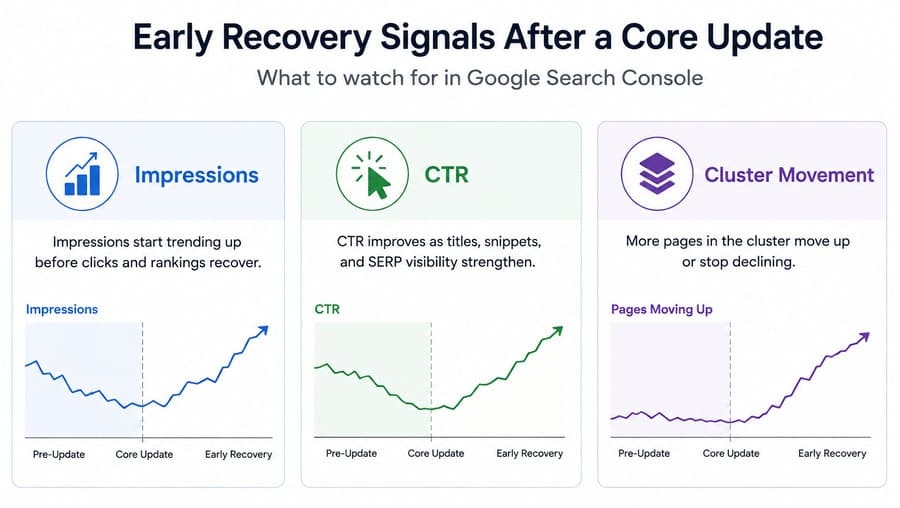
Rather than waiting for a full traffic rebound, which can take months, look for earlier leading indicators.
- Impressions (how often your pages appear in search results) stabilizing in the affected section of the site.
- Rankings beginning to partially recover or at least stop their decline.
- The right search terms now match the right pages more consistently.
- Click rates improving on pages where rankings have held steady.
- Pages in the sections you addressed begin to outperform the rest of the site before overall traffic recovers.
For example, a service page that lost 60% of its traffic after an update rarely recovers all at once. More often, impressions stabilize first, rankings stop falling, and click-through rates improve before overall traffic starts to return.
Patience is not optional here. Real recovery from a core update often takes months and may not become visible until a subsequent Google update re-evaluates the site. A site can meaningfully improve in quality well before that improvement registers in a traffic graph.
The simplest validation test: does the fix match the diagnosed failure mode? If it does, cluster-level movement in the right direction should begin to confirm it within a reasonable period. If it does not, further editing produces noise, not clarity.
This article sits at the center of the core update branch of the broader diagnostic framework. For adjacent problems: an overnight drop not tied to a confirmed update, a click-rate decline where rankings held, pages appearing in results but generating no clicks, the supporting articles covering each of those specific patterns are the next logical resources.
Still not sure what’s actually causing the drop?
Some traffic drops are straightforward. Others sit across multiple layers at once: rankings decline in one cluster, click rates fall in another, and credibility concerns affect the domain more broadly.
If you are struggling to determine whether the issue is a rankings problem, a mismatch between your content and what searchers now want, a trust or credibility gap, or a technical problem, a Manual SEO Audit can often identify the failure mode far faster than broad content rewrites.
FAQs
How long does it take to recover from a Google core update?
Recovery usually takes months, not days. In many cases, meaningful improvement is not visible until a later Google update re-evaluates the site, which is why short-term panic changes often do more harm than good.
Can a Google core update affect only certain pages?
Yes. Many sites experience losses isolated to a specific topic section, page type, or subject area rather than the entire domain. This is why page-level and section-level diagnosis should happen before sitewide changes are made.
How do I fix my website after a Google update drop?
Start with Google Search Console, not content rewrites. Identify whether the loss is driven by rankings, click-through rate, intent mismatch, technical disruption, or site-level trust weakness, then match the response to that failure mode.
Did the Google core update penalize my site?
Almost certainly not in the traditional sense. A core update is not a manual penalty or a spam action. In most cases, Google has re-evaluated the competing results and decided that other pages are a stronger fit for the searches your site was previously capturing.
Should I delete old content after a Google core update?
Sometimes, but only when a page has no unique value, duplicates a stronger page on the same site, or weakens a topic section by targeting the same audience as a page that performs better. Consolidating two weaker pages into one stronger one is often more effective than deleting either.
What if my rankings still exist but traffic is down?
That usually points to a click-rate problem or a change in what Google displays on the results page around your listing. Diagnose it separately before assuming your content is the main issue.