
Summary Answer Block:
A sudden traffic drop is usually caused by one of three things: a tracking issue, a ranking/visibility change, or a drop in click-through rate due to AI Overviews or SERP features. The first thing to check is whether your impressions dropped or only your clicks.
Why This Article Exists (And How It Complements the Main Guide)
When your website traffic drops overnight, the first thing you should check is whether your impressions, clicks, or tracking data changed, not your rankings.
In most cases I’ve worked on, the issue was not a lack of information; it was starting in the wrong place.
If you’ve just seen a sudden traffic drop, you don’t need a long list of possible causes. You need a clear starting point that tells you what to check first before taking any action.
That’s where this article fits.
- It acts as a fast triage layer
- It helps you identify the right starting signal
- It prevents you from fixing the wrong problem
If you want a deeper breakdown of how traffic can drop even when rankings stay stable, start with, Your Traffic Dropped but Your Rankings Didn’t Here’s What’s Actually Wrong
The Real Problem: You’re Diagnosing in the Wrong Order
Most sudden traffic drops are misdiagnosed because people start with rankings instead of verifying what actually changed.
Traffic drops and the first instinct is to check rankings.
If nothing obvious shows up, content edits follow, and then competitor analysis.
But this sequence assumes the problem is SEO, and that’s often incorrect.
In audits, especially for content-heavy and GDPR-affected sites, I often see drops caused by tracking issues, reporting changes, or consent configurations rather than actual ranking loss.
That’s why the order matters.
If you don’t first confirm whether the issue is measurement, rankings, or SERP behavior, you’ll almost always end up fixing the wrong thing.
“Check algorithm updates first” sounds logical, but in many cases, it’s wrong.
What I’ve noticed in real audits
In audits, especially for content-heavy and GDPR-affected sites, I often see sudden drops that have nothing to do with SEO performance at all.
They’re:
- Tracking issues in Google Analytics 4 (GA4)
- Reporting changes in Google Search Console (GSC)
- Consent-related data loss
Atomic Fact
I’ve seen cases where GSC impressions dropped overnight due to reporting changes, while actual clicks and visibility remained stable. Clicks stayed stable.
People rewrote content for no reason.
Decision Rule
If you start with content or rankings, you’re already assuming the problem is SEO.
And that assumption is often wrong.
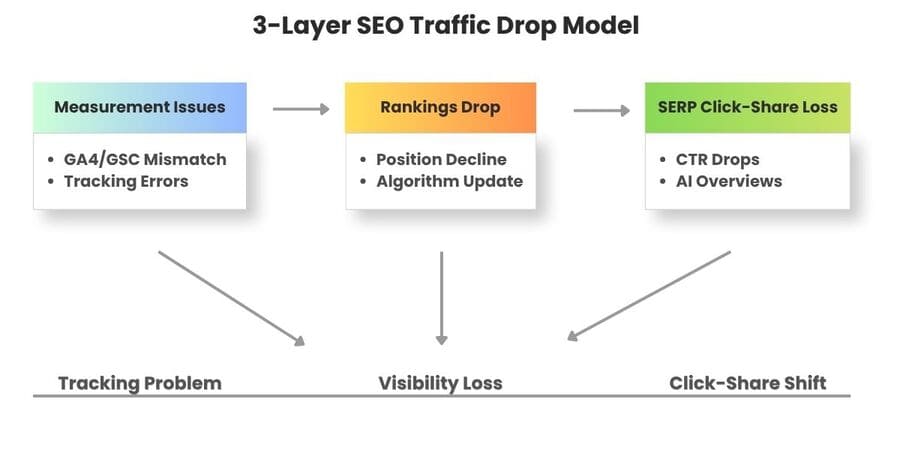
The 3-Layer Traffic Drop Model (What Actually Changed?)
Every sudden traffic drop comes from one of three layers: measurement, rankings, or SERP click-share.
If you don’t separate these, you’ll misdiagnose the problem.
This becomes clearer when you look at how traffic drops even with stable rankings, as explained in: Why Traffic Drops Without Ranking Loss.
Layer 1: Measurement (Tracking vs Reality)
Here, the data is wrong, not the traffic.
Common signals:
- GA4 shows a drop, but GSC clicks are stable
- Traffic loss only in certain regions, e.g. European Economic Area (EEA)
- Sudden drop after Consent Management Platform (CMP) or tracking changes
Typical causes:
- Consent mode issues
- Tracking script errors
- Analytics misconfiguration
Layer 2: Rankings (True Visibility Loss)
This is typically a genuine visibility loss, not just a reporting issue.
Signals:
- Impressions down
- Average position down
- Multiple pages affected
Important nuance:
This is not a “penalty” in most cases.
It’s a reassessment, especially after a Google Core Update.
Google itself clarifies that core updates are not penalties but broad reassessments of content quality. You can review the official explanation in Google Search Central’s Documentation on core updates.
Layer 3: SERP Click-Share (The 2026 Reality)
At this stage, most people get confused.
Your rankings are stable.
Your visibility is intact.
But your clicks are gone because the SERP is satisfying more of the query before the click.
Signals:
- impressions stable
- CTR down
- rankings unchanged
Cause:
- AI Overviews
- featured answers
- SERP features reducing clicks
Atomic Fact
Across many informational queries, sites have seen clicks decline even when top rankings are held.
That means:
Ranking alone is no longer a reliable proxy for traffic.
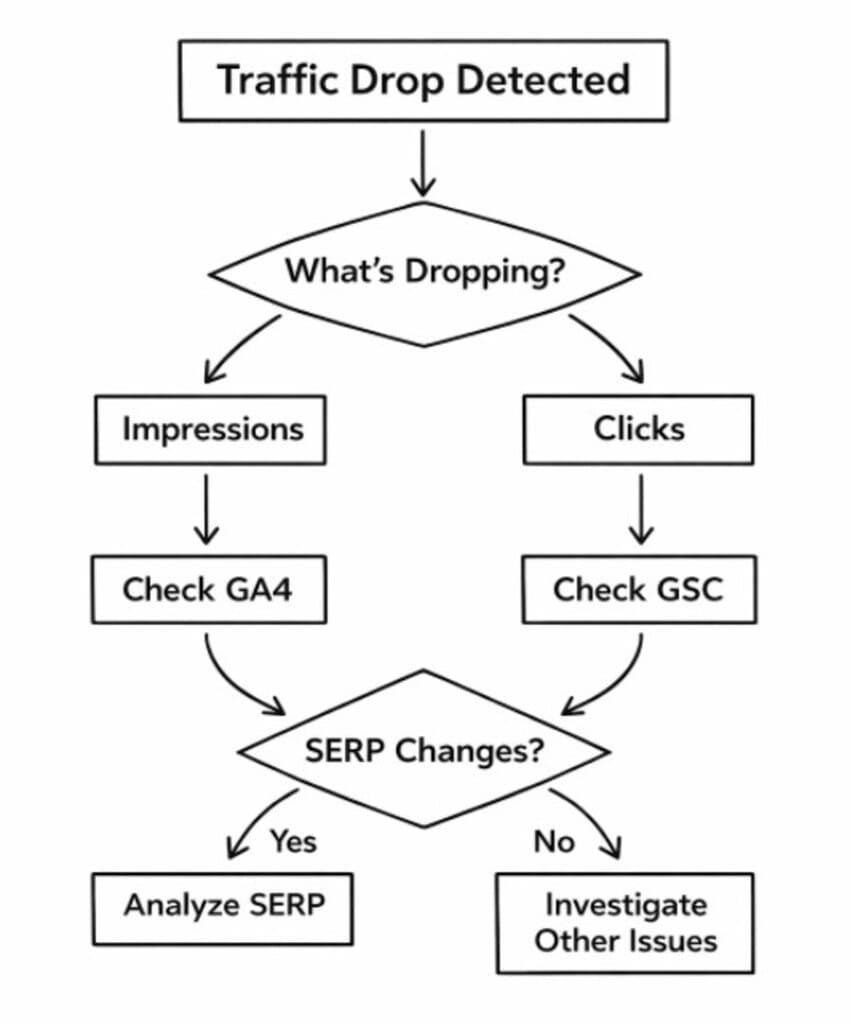
The 3-Step “Check This First” Diagnostic Flow (Under 5 Minutes)
If your site traffic suddenly dropped, this is the fastest way I’ve found to diagnose it.
Start here before you check updates, edit content, or audit competitors.
Step 1: Did Impressions Drop or Just Clicks?
Go to Google Search Console:
- Impressions stable → NOT a ranking issue (but still verify query-level changes before ruling it out completely)
- Impressions down → possible visibility loss
This single check eliminates half the confusion.
Step 2: Does GA4 Match Search Console?
Compare:
- GA4 users
- GSC clicks
If:
- GA4 down, but GSC stable → measurement issue
This is one of the most common false alarms.
Step 3: What Changed on the SERP?
Search your top queries manually.
Look for:
- AI Overviews
- new SERP features
- expanded answer boxes
If rankings are stable but CTR dropped, this is usually the cause.
Quick Decision Logic
- Clicks down + impressions stable → check SERP
- GA4 down only → check tracking
- Impressions down → check rankings
Experience-Led Insight: The 40% “False Drop” That Wasn’t SEO
I’ve seen this exact situation play out more than once.
One case stood out.
We saw a 40% drop overnight.
First reaction:
- check rankings
- check indexing
- check updates
Everything looked normal.
Then we compared:
- GSC clicks → stable
- GA4 users → dropped
At that point, the instinct is to “fix SEO,” but there’s nothing to fix, and that’s where most time gets wasted.
The issue?
A consent configuration change had stopped GA4 from tracking a large portion of users.
Traffic didn’t drop.
The reporting did.
What stood out
The drop looked real in dashboards, but there was no corresponding change in actual user behavior.
That’s when it becomes clear; misdiagnosis is often more damaging than the drop itself.
Because once you start fixing the wrong thing:
- You waste time
- You introduce new problems
- Sometimes you damage rankings that were never the issue
Layer-by-Layer Quick Checks
You don’t need a full audit to confirm the layer.
You just need the right signals.
Measurement Layer
Confirming signals:
- GSC stable, GA4 down
- Drop is limited to specific regions
- Timing matches tracking changes
Ranking Layer
Confirming signals:
- Impressions down
- Position down
- Multiple pages affected
SERP Layer
Confirming signals:
- Clicks down
- Impressions stable
- CTR drops across queries, so this usually happens because SERP features reduce the need to click.
- AI Overviews visible
Stable rankings no longer guarantee stable traffic.
This is one of the biggest shifts in SEO right now.
Why Fixing Content First Often Makes Things Worse
Most guides tell you:
“Update content. Improve quality.”
That’s not wrong.
But it’s often premature.
Google confirms that core updates are not penalties but broad reassessments of content quality and relevance.
In one informational content site I worked on:
- Rankings recovered
- Impressions returned
But traffic stayed 35% lower.
Why?
Because AI Overviews had taken the clicks.
Atomic Fact
Recovering rankings no longer guarantees recovering traffic.
Decision Rule
Only fix content after ruling out:
- Measurement issues
- SERP click-share loss
Otherwise, you’re solving the wrong problem.
When This Is NOT a “Fixable” SEO Problem
Not every drop is recoverable.
That’s a hard truth, but an important one.
Cases where recovery is limited
- AI Overviews answering queries directly
- Zero-click search behavior
- Demand shifts in the topic
I’ve seen this frustrate site owners the most. Everything looks fine on paper, rankings hold, content hasn’t changed, but traffic still declines.
What this means
In many cases, this isn’t an SEO issue at all; it’s a shift in how users interact with search results.
For a deeper breakdown of this scenario, especially when rankings are stable but traffic drops, refer to:
→ Your Traffic Dropped, but Your Rankings Didn’t. Here’s What’s Actually Wrong
What to Do After You Identify the Layer
Once you know the layer, the path becomes clear.
Measurement Issue
In most cases, this gets resolved once you validate where the tracking broke, not by changing anything SEO-related. I’ve seen this fix restore “lost” traffic without touching content.
- Validate tracking
- Compare GA4 vs GSC
- Confirm data accuracy
Ranking Issue
Actual SEO work starts here, but only after you’re certain visibility has genuinely dropped.
- Review content quality
- Assess trust signals
- Evaluate competition
SERP Issue
Here, the goal is not improving rankings, but understanding how much the click opportunity has changed.
- Monitor CTR trends
- Analyze SERP features
- Adjust for visibility vs click-share
The key is simple:
match the fix to the cause.
Advanced Diagnostic Validation
At this stage, a structured AI-generated content audit for E-E-A-T helps validate deeper trust and quality issues.
Advanced validation involves:
- Cross-checking GA4, GSC, and server logs
- Analyzing segmented data (device, geography, page type)
- Identifying patterns across page clusters
This is where surface-level diagnosis ends and deeper analysis begins. The exact validation process depends heavily on the site structure and data quality.
SERP-Level Click Loss Analysis
Diagnosing SERP-level loss requires:
- Measuring AI Overview presence across queries
- Analyzing CTR decline patterns
- Comparing click-share over time
This is not just about seeing changes; it’s about quantifying impact at the query level, which requires structured analysis beyond basic tools.
FAQs
Why did my website traffic drop overnight?
A sudden traffic drop usually comes from tracking issues, ranking changes, or SERP-level click loss. The fastest way to diagnose it is by comparing impressions, clicks, and rankings in Google Search Console before making any changes.
Clicks dropped, but impressions stayed the same. What does that mean?
This typically indicates a SERP-level change, such as AI Overviews or featured results reducing click-through rates, not a ranking loss.
How do I know if it’s a tracking issue or real traffic loss?
If GA4 shows a drop but Search Console clicks remain stable, it’s likely a measurement issue rather than an actual decline in users.
Should I update content after a traffic drop?
Only after confirming the issue is due to ranking loss. Content updates won’t fix tracking errors or SERP-driven click loss.
Final Takeaway
You didn’t just lose traffic but you started with the wrong signal.
The difference between recovery and wasted effort isn’t effort.
It’s diagnosing the right layer before you act.
If you’re unsure which layer is causing the drop, a Google traffic drop recovery consultation can help identify the exact issue before you take action.