

Summary Answer Block:
Traffic can drop even when rankings stay the same, usually because fewer people are clicking, not because you lost visibility. In most cases, the issue comes down to click-through changes, tracking gaps, or demand shifts, which you can confirm by comparing clicks, impressions, and analytics data.
The 5-Minute Diagnosis Logic
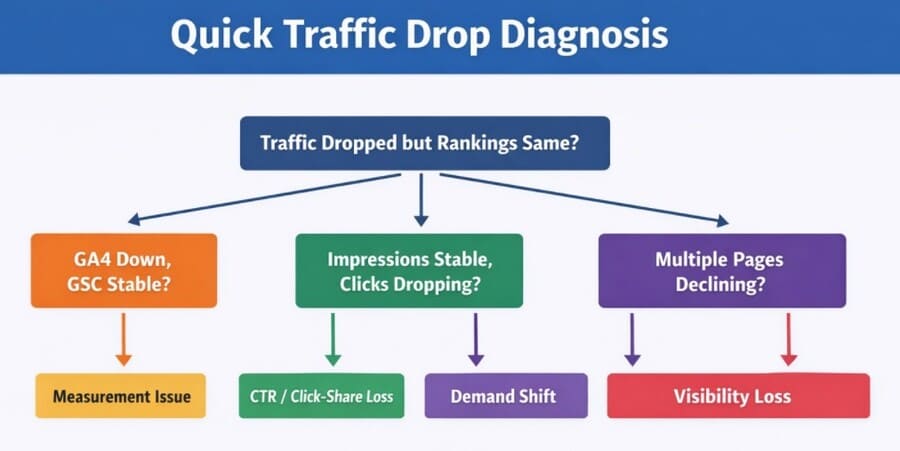
If your traffic dropped but rankings stayed the same, the problem is usually not visibility but changes in clicks, demand, or tracking. Start with this quick check. It tells you what actually changed before you touch anything else.
Step-by-step diagnostic:
- Is GA4 traffic down, but GSC clicks stable?
Measurement issue - Are impressions stable but clicks down?
Click-through rate (CTR) / click-share loss - Are multiple pages or topics declining?
Demand shift - Are impressions + positions both down?
True visibility loss
What stood out to me in these cases, while testing this across different site types:
- Most teams skip this step
- They jump straight to content changes
- That’s where things go wrong
If your traffic dropped but rankings stayed the same, don’t rewrite the page first. Check measurement, click-through rate, demand, and visibility in that order.
This article focuses on one specific pattern: traffic dropped but rankings stayed the same. For a complete breakdown of all possible traffic drop scenarios, refer to the full traffic drop diagnostic framework.
The Core Shift Most People Miss
Even with stable rankings, traffic can drop because how users interact with the SERP has changed.
This is the first thing I noticed when analyzing multiple sites: rankings held steady, but clicks didn’t follow. That shift explains why traffic can drop without rankings moving. Now let’s break down the exact reasons this happens.
Rankings are now a lagging metric
We’ve been trained to treat rankings as the primary KPI. But in reality:
- Position #1 CTR has dropped ~58-68% in AI-influenced SERPs
- Many #1 pages now get less traffic than #3 or #4 used to
So when someone says “your rankings are fine, just wait” — that’s outdated advice.
What’s changed here:
The real shift is happening at the visibility layer:
- AI Overviews answer queries instantly
- Featured snippets reduce the need for clicks
- Users consume answers across platforms (Reddit, YouTube, AI tools)
AI Overviews are not the only cause
Even queries without AI Overviews show CTR decline.
That means:
- The problem isn’t just Google. It’s multi-channel answer consumption.
- This is no longer a ranking problem. It’s a click-share + visibility problem.
Experience Insight: What Actually Happens in Real Sites
Most traffic drops without ranking changes are not SEO problems; they are misdiagnosed problems.
I analyzed 11 sites over a 3-month period, mostly content-driven and lead-gen sites ranging from ~10K to 200K monthly visits.
Here’s what I found:
- 4: tracking/measurement issues
- 3: click-share loss (SERP changes)
- 2: demand shifts
- 2: actual ranking loss
What stood out
- More than 70% were NOT ranking-related
- Yet almost every team initially assumed they were
One case that illustrates this clearly:
A page held position #1 for months. Traffic dropped ~44%. No content changes. No penalties. The cause was AI Overview adoption on that query, combined with progressive CTR decay on the organic result beneath it. In a couple of cases, I initially misread this as a ranking issue until the CTR data told a completely different story.
The bigger risk isn’t the drop itself, but it’s spending weeks trying to fix the wrong issue.
Once you identify which signal changed, use the four causes below to confirm the pattern. Start with tracking, then click-share, then demand, and only treat it as a true SEO issue when the data supports it.
Reason 1: Phantom Traffic Drop (Tracking Is Broken, Not Traffic)
A phantom drop means your analytics shows a decline, but actual traffic hasn’t changed.
This is more common than most people think, especially in traffic drop Google Analytics scenarios.
What I check first in these cases
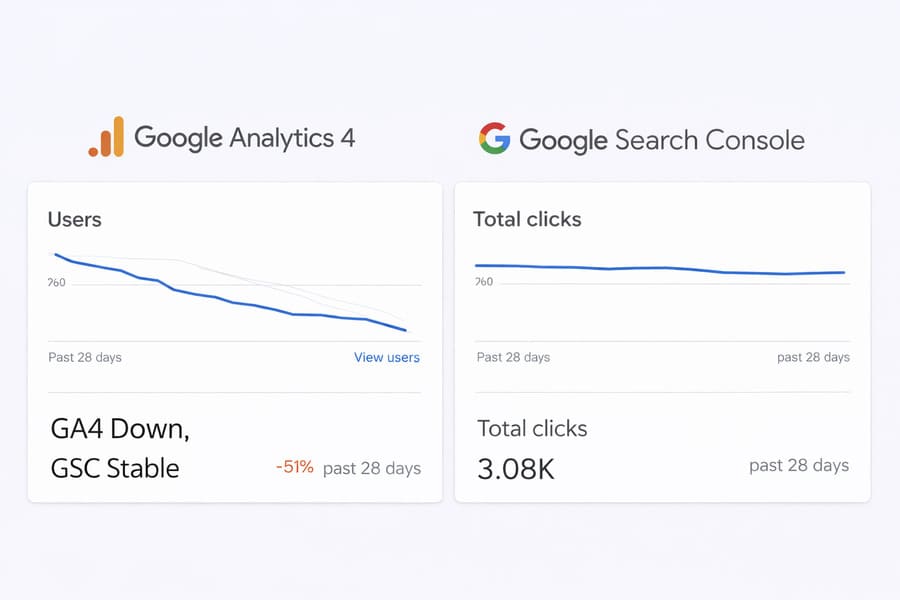
- Compare Google Search Console vs Google Analytics 4
- Look for mismatch patterns
One pattern I see often: consent or tracking changes quietly break GA4 data, especially on sites with EU traffic.
Common causes
- Consent Mode / CMP changes
- GA4 misconfiguration
- Cookie rejection (especially in EU traffic)
Detection checklist
- GSC clicks stable
- Server logs stable (if available)
- The Drop is isolated to certain regions
- Timing matches tracking changes
Decision rule:
If GA4 drops but GSC doesn’t, assume a measurement issue first.
Reason 2: Click-Share Loss (Your Rank Is Fine, Your Clicks Aren’t)
Rankings stayed the same, but fewer people are actually clicking through.
This is one of the most common patterns behind traffic drops today.
What’s happening
SERP features are absorbing clicks:
- AI Overviews
- Featured snippets
- People Also Ask
Users get answers without clicking.
Key signal
- Impressions steady or rising
- CTR declining
This pattern shows clearly inside Google Search Console.
Reason 3: Demand Shift (It’s Not SEO, It’s Market Behavior)
Sometimes traffic drops because people are searching less, not because your SEO failed.
What I check
- Is the drop across multiple pages?
- Are competitors also declining?
- Is it seasonal?
Signals
- Cluster-wide decline
- Stable rankings
- No major SERP changes
Decision rule
If decline is broad, check demand before editing content.
Mistake I see often
Teams often rewrite stable pages when the real issue is that the topic itself is getting searched less than before. The content isn’t broken; the demand has shifted.
Reason 4: True Visibility Loss (Actual SEO Problem)
This is the only case where SEO fixes are actually required.
What defines it
- Rankings dropped
- Impressions dropped
- Multiple pages affected
Signals
- Clear position decline in Google Search Console
- Update timing alignment
- Site-wide or cluster-wide impact
Important
This is the last bucket, not the first.
Most people start here. That’s the mistake.
Investigation Workflow (Exact Order Matters)
The correct diagnosis sequence prevents wasted effort.
Step-by-step workflow
- Verify measurement (GA4 vs GSC)
- Compare clicks vs impressions
- Check live SERPs
- Evaluate demand
- Confirm visibility loss
You can validate demand shifts using tools like Google Trends to see whether search interest for a topic has declined over time.
One thing I’ve noticed consistently
Skipping this order leads to:
- Unnecessary content rewrites
- Incorrect technical fixes
- Delayed recovery
What To Do After Diagnosis
Once you identify the cause, fix tracking issues if it’s a measurement problem, improve SERP visibility if clicks have dropped, adjust your content strategy if demand has declined, and only run a full SEO audit if there’s clear visibility loss.
When dealing with sudden drops, also refer to My Website Traffic Dropped Overnight: What Should I Check First?
Practical Recovery Lever Most Guides Miss
You need to optimize for SERP positioning, not just content quality, by running a structured AI content audit for EEAT and trust.
Fixing content alone is not enough anymore.
Content updates do NOT guarantee traffic recovery.
What tends to work in practice
You need to optimize for SERP positioning, not just content quality:
- Answer-first formatting
- Snippet targeting
- Citation-friendly structure
Where most guides fall short
They stop at “update content.”
But the real question is:
Can your content be extracted, cited, and surfaced?
FAQs
Why did my traffic drop but rankings stayed the same?
Traffic dropped because your click-through rate declined. This usually happens due to SERP changes like AI Overviews or featured snippets that reduce clicks, even when your ranking position remains stable.
Is this a Google penalty?
No. If rankings are stable, it is rarely a penalty. Traffic drops in this case are usually caused by CTR decline, demand shifts, or tracking issues rather than algorithmic penalties.
How do I confirm the real cause?
Compare clicks vs impressions in Search Console, validate GA4 accuracy, check SERP changes manually, and analyze demand trends. This layered approach helps isolate the exact cause quickly.
Can traffic recover without ranking changes?
Yes. Traffic can recover by improving click-share, optimizing for SERP features, and increasing visibility in AI-generated answers, even if rankings remain unchanged.
My Google traffic dropped but Search Console shows no change. Why?
This often points to either a tracking issue or changes in how users click on results, not necessarily a real traffic drop. If clicks in Search Console are stable but GA4 shows a decline, check consent settings, tracking setup, or data loss before assuming an SEO problem.
Advanced Diagnostic Audit:
At this stage, surface-level checks are not enough.
A deeper audit typically includes:
- Query-level CTR analysis
- SERP feature tracking
- Segmentation by device, geography, and intent
For example, when you break CTR down at the query level, you often find that a few high-impression queries lost clicks due to SERP changes, even though overall rankings stayed the same.
This level of analysis helps identify patterns that are not visible in dashboards alone.
This is where dashboards stop being enough; you need to look at query-level patterns to understand what’s changed, actually.
Recovering traffic increasingly depends on how your content interacts with AI-driven SERPs.
At a high level, this involves:
- Structuring content for extraction
- Reinforcing entity clarity
- Improving answer formatting
The goal is not just to rank, but to be selected as a source. At this stage, using a detailed AI content review checklist helps identify gaps at the query level.
The exact implementation varies significantly by site and query type.
Final Takeaway
If your traffic dropped but rankings stayed the same, the issue is usually not SEO performance; it’s measurement, click behavior, or demand. Start by checking clicks, impressions, and analytics side by side, which usually tells you what has affected before you touch anything.
If you’ve gone through this checklist and you’re still not certain what’s driving the drop, that’s usually the point where a second set of eyes helps. I offer a manual SEO audit built specifically for this kind of diagnosis with no guesswork, just a clear answer on what changed and why.