

Introduction: Why E-E-A-T Matters More Than Ever
If you’re using AI to create content today, you already know the struggle. It’s a practical, no-fluff E-E-A-T checklist built specifically for AI-assisted content.
You’re publishing faster, you’re covering topics well, and yet rankings feel harder to earn, not easier.
What’s become clear while testing AI‑assisted workflows this year is simple: Google isn’t punishing AI, it’s filtering trust.
With AI Overviews, zero‑click results, and a flood of generic AI pages, only content that demonstrates real E‑E‑A‑T stands out.
This checklist is for SEO teams, content leads, and solo publishers who use AI tools but still want to protect rankings, trust, and revenue. It’s a practical, no‑fluff.
Summary:
This checklist explains how to evaluate AI-assisted content using Google’s E-E-A-T quality framework, focusing on real experience signals, verified expertise, topical authority, and visible trust indicators.
What E-E-A-T Really Means Today
Google explains E-E-A-T primarily through its Search Quality Rater Guidelines, which human evaluators use to assess content quality and trustworthiness across experience, expertise, authority, and trust.
E-E-A-T stands for:
- Experience – first-hand use, real involvement
- Expertise – subject knowledge and accuracy
- Authoritativeness – reputation and recognition
- Trustworthiness – transparency, safety, honesty
What’s often overlooked is that trustworthiness acts as the foundation through which experience, expertise, and authority are evaluated.
Google’s Search Quality Rater Guidelines call trustworthiness the most important E-E-A-T member, shaping how all other signals are evaluated.
For a deeper breakdown of how E-E-A-T fits into ethical, AI-assisted SEO, read our pillar guide: Trusted AI SEO Foundations: E-E-A-T, Ethics & Safe AI Use.
Current E-E-A-T Audit Checklist (Core Framework)
This is the heart of the article.
The E-E-A-T checklist is structured around how Google evaluates content quality, not how SEO tools score it.
While E-E-A-T is not a ranking factor, it influences how Google evaluates content quality by helping distinguish original, trustworthy pages from generic or unverified ones.
Experience Checklist: Prove Real-World Use
This is where most AI content fails.
Ask yourself:
- Did I personally test, use, or analyze this?
- Can I prove it visually or contextually?
Experience checklist:
- ☐ Add first-hand insights (“What I tested…”, “What I noticed…”)
- ☐ Include original screenshots or photos
- ☐ Show outcomes (before/after, results, observations)
- ☐ Use examples AI couldn’t realistically invent
- ☐ Add “Experience verified by…” where relevant
- ☐ Add at least one concrete story (test, experiment, or client example) per article, even if it’s short
- ☐ For example, instead of listing tool features, add a sentence like: ‘After using this tool daily for three days, I noticed export limits became restrictive on larger projects.’
Good vs Bad Example
- ✅ Good: Tool review with real screenshots + usage notes
- ❌ Bad: Generic feature list rewritten from other blogs
Real example from our own tests:
For one AI-written “best tools” roundup, we rebuilt the article after actually trying each tool for 3–5 days, adding real screenshots, failure points, and notes like “What surprised me most was…”.
In internal tests, adding firsthand usage notes, screenshots, and outcome-based observations consistently produced measurable engagement improvements compared to generic AI-only drafts.
In one internal test, we rebuilt a single high-intent tools page targeting ~8–10 related queries. After adding real usage, screenshots, and experience notes, organic clicks increased by 32% over 45 days compared to the AI-only version.
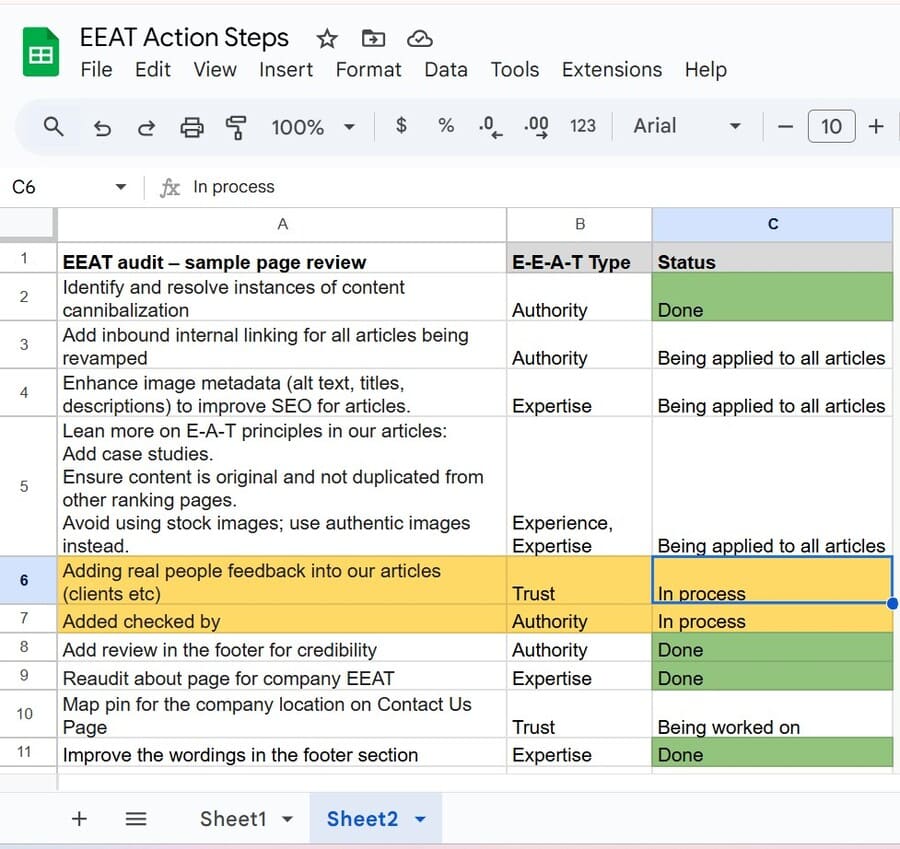
Here’s a step-by-step guide to improving AI content quality using real experience signals, human review, and SEO best practices: How to Optimize AI-Generated Content for Google
Expertise Checklist: Show You Know the Topic
Expertise isn’t fancy language. Its accuracy, clarity, and accountability.
Expertise checklist:
- ☐ Clear author identity (not “Admin”)
- ☐ Relevant credentials or experience
- ☐ Claims supported by citations
- ☐ Fact-checked content
- ☐ SME review for YMYL topics
- ☐ Updated stats with timestamps
- ☐ Run a quick “credential check” before publishing: is the listed author actually qualified to talk about this topic?
- ☐ For key money pages, schedule a Subject Matter Expert review at least once every 6–12 months.
- ☐ Relevant credentials may include hands-on experience with AI tools, published research or case studies, professional SEO experience, or a documented history of writing on AI and search topics.
What I’ve seen in practice: even non-YMYL blogs tend to perform better when readers can see who wrote the article, why they’re qualified, and when it was last reviewed.
A deeper explanation of how Google evaluates expertise, authorship, and credibility in AI-assisted content: E-E-A-T for AI Content (Explained)
Authoritativeness Checklist: Build Entity Signals
Authority is not just backlinks.
It’s about consistent topical presence.
Authoritativeness checklist:
-
- ☐ Clear topical cluster structure
- ☐ Internal links between related articles
- ☐ Mentions or citations from relevant sites
- ☐ Author pages with multiple related posts
- ☐ Schema (Author, Organization, FAQ)
- ☐ Social proof where applicable
- ☐ Map each author to at least one topical cluster where they publish repeatedly (instead of writing about everything).
- ☐ Once per quarter, identify 3–5 “pillar” pages and strengthen their authority with fresh internal links and updated references.
Competitor gap: most sites talk about authority; very few show a simple, repeatable system for building it across topics, authors, and time.
Trustworthiness Checklist: Make Trust Obvious
Trust signals should never be hidden.
Trust checklist:
- ☐ HTTPS enabled
- ☐ Clear About + Contact pages
- ☐ Real author profiles
- ☐ Editorial guidelines published
- ☐ Affiliate & ad disclosures
- ☐ Content update logs
- ☐ A strong About page should clearly explain who runs the site, why it exists, and how content is reviewed, while the Contact page should offer a real method to reach the publisher.
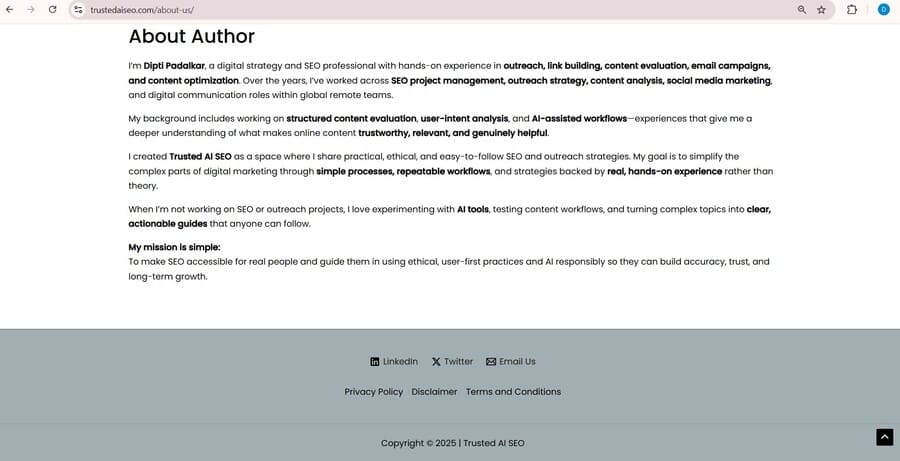
AI Content Quality Addendum
This is where this E-E-A-T checklist goes beyond most E-E-A-T articles: it focuses on the AI workflow itself, not just on-page tweaks.
Human Review Is Non-Negotiable
For a structured, post-publish validation process, follow a formal AI content audit process to catch accuracy and trust gaps at scale.
AI drafts ≠ published content.
Checklist:
- ☐ Human editor assigned
- ☐ Fact-checking completed
- ☐ Bias review done
- ☐ Final accountability declared
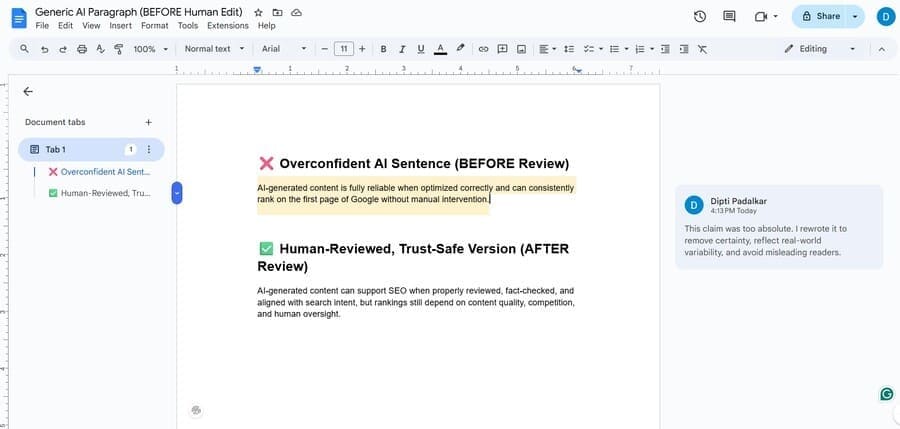
This aligns directly with Google’s public guidance on AI-generated content, which emphasizes that responsibility for quality matters more than how the content is created.
AI Transparency (Optional but Powerful)
Disclosure isn’t mandatory, but it builds trust.
Best practice:
“This article was AI-assisted and reviewed by a human editor.”
Originality: Escape AI Paraphrase Patterns
Improve originality by:
- Adding personal opinions
- Including screenshots
- Creating your own frameworks
- Rewriting AI phrasing in your voice
- Replace one AI-generated section with your experience
E-E-A-T-Focused Prompting (High Level)
We keep our full prompt libraries for clients and premium resources, but at a high level, you should always:
- Prompt for experience
- Prompt for sources
- Prompt for nuance
- Prompt for tone consistency
Download the full AI Content Quality Resource Bundle, including checklists and frameworks for E-E-A-T-aligned AI content: AI-Ready Content Quality Playbook (Free)
Current E-E-A-T Scoring Model (Public Version)
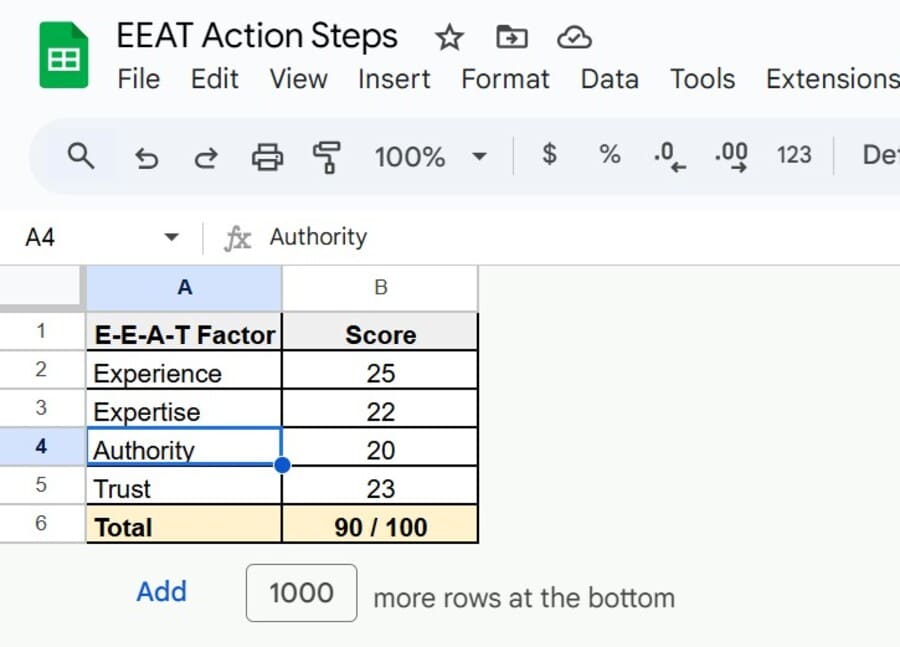
Score each pillar out of 25:
- Experience: 25
- Expertise: 25
- Authority: 25
- Trust: 25
Score interpretation:
- 0–40: High risk
- 40–70: Needs work
- 70–90: Strong
- 90+: High trust
This gives you clarity without overcomplication.
Good vs Bad E-E-A-T Examples
Good E-E-A-T looks like:
- Real author with visible credentials
- First-hand experience (screenshots, tests, observations)
- Clear citations and update dates
- Transparent AI usage and human review
Bad E-E-A-T looks like:
- Anonymous pages (e.g., “Admin” or no author listed)
- Generic ‘best X tools’ roundups – no screenshots, no usage notes
- Paraphrased summaries matching multiple competing pages
- No accountability or editorial ownership
15 Quick E-E-A-T Wins (Implementation Snapshot)
- Add author bios → tie to niche and credentials
- Add schema → Author, Organization, FAQ markup
- Cite sources → prefer primary or official docs
- Add screenshots → show real usage or outcomes
- Add last updated dates
- Add FAQs
- Fix broken links
- Improve internal links
- Add disclosures
- Publish editorial policy
- Remove fluff
- Add experience notes
- Improve About page
- Improve headings
- Update old content
Common E-E-A-T Mistakes
- Publishing AI content without review
- Fake author profiles
- Thin content at scale
- No update process
- No citations
- Ignoring entity building
Implementation Roadmap
- Phase 1: Audit – Score a sample of 10–20 key pages using the structured AI content review checklist to validate claims, experience signals, and accountability before publishing.
- Phase 2: Fix trust gaps – Prioritize obvious trust issues first (missing authors, no disclosures, weak About/Contact pages, outdated content).
- Phase 3: Strengthen authorship – Improve author bios, add credentials, link to social profiles, and align each author with a clear topical cluster.
- Phase 4: Improve AI workflow – Formalize how AI is used: prompts, human review, fact-checking, and final accountability.
- Phase 5: Quarterly reviews – Re-run the E-E-A-T checklist every quarter on top pages and refresh scores, examples, and references.
Note: Detailed implementation frameworks, templates, and workflows are part of our premium guidance.
FAQs
Q: Is Google E-E-A-T still relevant now?
A. Yes. More than ever, especially with AI-generated content.
Q: Does E-E-A-T directly affect rankings?
A: No. It’s a quality evaluation framework, not a direct ranking factor, but strong E-E-A-T helps Google identify helpful, trustworthy content.
Q: Can AI content meet E-E-A-T standards?
A: Yes. When humans add firsthand experience, verify facts, and take editorial responsibility. AI can assist with drafting, but E-E-A-T depends on human oversight.
Q: Is there an official Google E-E-A-T checklist?
A. No. E-E-A-T is a framework from Google’s Search Quality Rater Guidelines, not a direct algorithmic checklist. This checklist is designed to align with those quality principles.
Conclusion
E-E-A-T isn’t a checkbox. It’s a trust system.
AI can help you scale, but only humans can earn trust.
Use this checklist to:
- Audit your current content honestly.
- Fix the biggest trust gaps first.
- Scale AI-assisted publishing without sacrificing quality.
👉 Next steps:
- Download the E-E-A-T Improvement Template to score your own pages and prioritize fixes.
- Take the 5-Minute E-E-A-T Score Quiz to see where your current workflow is weakest.
- If your traffic has declined or rankings feel unstable, you can Book a Traffic Recovery Consultation for a focused diagnostic.