

Introduction:
If you’re using AI to create content regularly, you’ve probably felt this tension already.
You publish faster.
You cover topics thoroughly.
And yet… something feels off.
I noticed it the first time I reviewed one of my own AI-assisted drafts side-by-side with a human-written piece. On paper, the AI version was “correct.” Grammatically clean. Structured. Even SEO-optimised.
But it didn’t sound like me.
And more importantly, it didn’t feel like something I’d trust if I were the reader.
That’s the real struggle behind how to humanize AI content searches today. It’s not just about rankings or AI detectors. It’s about credibility, voice, and whether your content actually deserves attention.
In this guide, I’ll walk you through:
- What humanized AI content actually looks like
- Why “undetectable AI” is the wrong goal
- A practical 4-stage workflow I personally use
- Real before/after examples
- Prompts, tools, and checks that improve quality without killing efficiency
No hype. No shortcuts. Just a clear, repeatable way to make AI content sound human because it adds value, not because it’s trying to hide.
After reviewing, editing, and publishing AI-assisted content across multiple articles, I’ve learned that speed alone doesn’t build trust; clarity and judgment do.
Diagnostic insight from practice:
Across multiple AI SEO audits after recent Google updates, one pattern keeps repeating. Pages are not ignored because they use AI. They are ignored because they do not add anything new.
This is what I call the “information gap.”
If your content only summarizes what already exists, Google has no reason to index it. To rank today, every section must add something that the top results are missing, whether that is a real observation, a trade-off, or a practical limitation.
This approach comes directly from analyzing real indexing patterns, not just content guidelines.
AI Overview Summary:
Most AI content does not get indexed because it lacks information gain.
Google does not filter content based on whether AI is used. It filters content that does not add new value beyond what already exists.
From practical audits, three factors consistently improve indexing:
- Experience signals, such as real observations and trade-offs
- Clear reasoning that explains why something matters
- A defined point of view instead of generic explanations
The workflow in this guide shows how to apply these elements step by step to make AI-assisted content more useful, more trustworthy, and more likely to rank.
What Humanized AI Content Looks Like
Before we fix anything, it helps to know what we’re aiming for.
Common signs of AI-generated content
From reviewing hundreds of competitor articles and drafts, these patterns show up repeatedly:
- Overly neutral tone (no opinions)
- Predictable sentence structures
- Generic transitions (“In conclusion,” “Moreover,” “Additionally”)
- Vague claims without context or experience
- No sense of who is speaking
None of these are “penalties.” But together, they create content that feels disposable.
What humanized content do differently?
Humanized AI content:
- Sounds like a real person with a point of view
- Includes specific observations, not just summaries
- Uses natural transitions (“Here’s the thing,” “What surprised me”)
- Explains why something matters, not just what it is
- Feels written for a specific reader with a specific problem, not for everyone at once
Quick self-check: Is your content still robotic?
- Could this article be written by anyone?
- Does it include real judgment calls?
- Would you trust it without checking another source?
If the answer is “not really,” you don’t need less AI. You need better humanization.
Why “Undetectable AI” Is the Wrong Goal
When I tested AI drafts across multiple detection tools, the results were inconsistent at best. The same paragraph could score as “AI-written” in one tool and “human” in another, sometimes minutes apart, without meaningful edits.
That’s because AI detectors don’t measure quality or trust. They estimate probability based on patterns, not value. This aligns with Google’s guidance on AI-generated content, which makes it clear that how content is created matters less than whether it is helpful, original, and trustworthy.
What actually matters in practice:
I do not optimize for detection scores. I optimize for identifiable expertise.
When I audit AI-assisted content, I look for signals that cannot be generated by default, such as:
- A clear point of view
- A trade-off or limitation
- A decision explained with reasoning
If those elements are missing, the content usually struggles to get indexed, not just ranked.
Google evaluates AI-assisted content using the same trust signals it applies to human-written pages, which is why E-E-A-T for AI-assisted content matters far more than detector scores.
I’ve broken this down further in my AI content quality and E-E-A-T guides, where I explain how these signals connect to indexing, rankings, and long-term traffic stability.
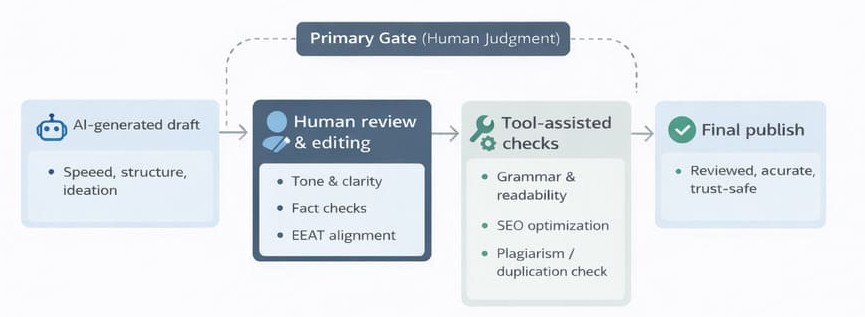
The 4-Stage Humanization Workflow
Most competitors list tips. This is the actual workflow I use.
Stage 1: Generate a Strong AI Draft
Bad prompts create drafts that need heavy rewriting. Good prompts save time.
What I do differently: I don’t ask AI to “write an article.” I ask it to think like an experienced practitioner.
Example prompts that work
- “Write this section as if you’ve tested this in real projects and noticed patterns.”
- “Explain this to someone skeptical, acknowledge limitations.”
- “Use a conversational, first-person expert tone. Avoid generic advice.”
This alone improves the baseline dramatically.
Stage 2: The Human Touch Pass
This is the most important step, and the one tool can’t replace.
Google evaluates AI-assisted content through the same trust signals it applies to human-written pages, which is why E-E-A-T for AI-assisted content matters throughout this workflow.
I use a simple 5-step editing pass:
- Voice – Does this sound like me?
- Syntax – Are sentences varied and natural?
- Emotion – Does it acknowledge reader frustration?
- Specificity – Are there real observations?
- Flow – Would someone enjoy reading this?
Before publishing, I run a quick AI content review checklist to confirm the article shows real expertise, clarity, and accountability.
Human Touch Hierarchy (What actually moves rankings):
From auditing AI-assisted content, not all edits contribute equally.
- High impact: Personal experience, real observations, and trade-offs that come from doing the work. These are the strongest signals of original insight.
- Medium impact: Conversational flow, sentence variety, and natural transitions that improve readability and engagement.
- Low impact: Grammar fixes, synonym swaps, and surface-level edits that do not change the value of the content.
In practice, pages that focus only on low-impact edits are the ones that get crawled but not indexed.
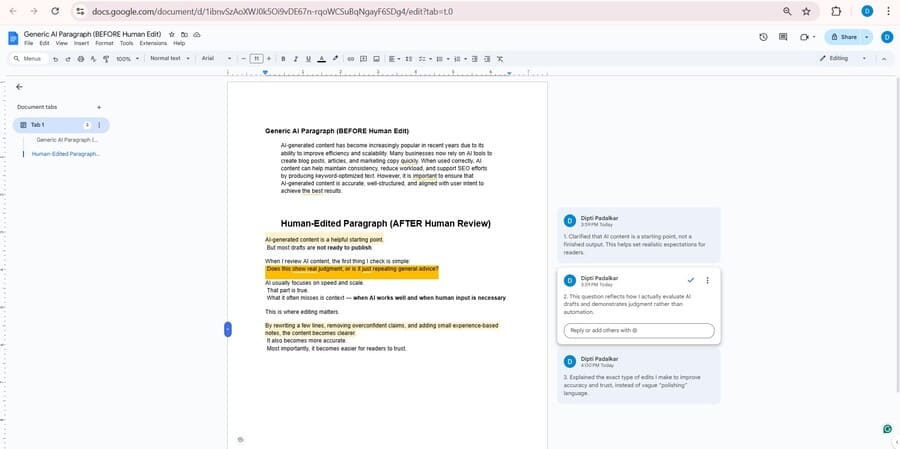
Note: Screenshot taken from an actual AI-assisted draft during final edit
Stage 3: Smart Tool Usage
I’m selective here. Tools should assist and not override judgment.
How I use tools
- Improve flow and readability
- Catch awkward phrasing
- Sanity-check tone
What I don’t use them for
- Rewriting everything
- “Making it undetectable.”
- Replacing expertise
A tool can smooth language. Experience still comes from the editor.
Stage 4: Detection, Polishing & E-E-A-T Check
I occasionally run a light AI detection check; not as a goal, but as a diagnostic. If something flags consistently, it’s usually a sign the content lacks specificity or human judgment, not that it needs trickery.
In practice, I’ve seen human-edited AI articles outperform raw drafts on engagement metrics like scroll depth and time on page, even when rankings are similar.
What usually blocks indexing:
If a page is crawled but not indexed, the issue is rarely technical. In most cases, the content lacks clear differentiation.
In audits, I have seen this happen when:
The content repeats common advice without adding new context. There is no clear author perspective.
Sections answer “what” but not “why it matters.”
Improving these areas often leads to indexing without any technical changes.
Practical Before & After Example
Before (AI draft):
“Humanizing AI content is important for SEO and user engagement.”
After (Humanized):
“What stood out during testing is that humanized AI content doesn’t just rank better, it keeps readers on the page longer because it actually answers the why, not just the what.”
Why this works
- Adds observation
- Adds context
- Signals experience
What this signals to Google:
This shift adds what search systems look for, which is not just clarity, but contribution. The second version introduces a real observation, which increases the likelihood of the page being indexed and retained.
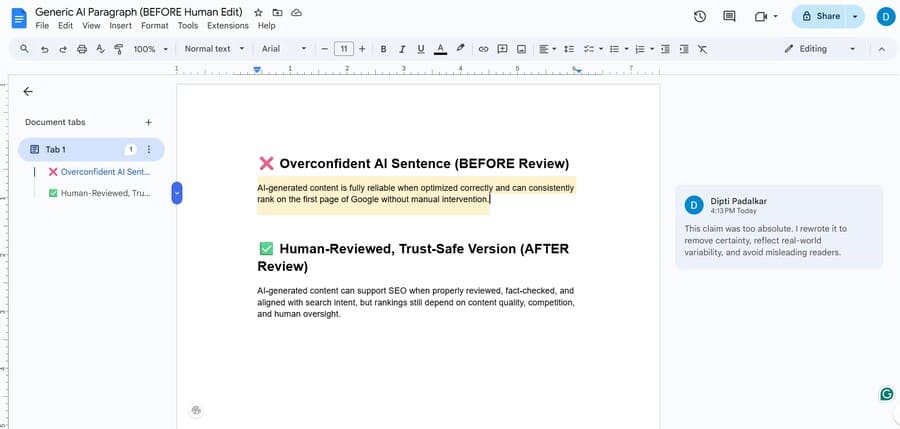
Note: Example based on an actual AI draft revised during content editing
Humanizing Content Is Only One Part of Making It Perform
Adding voice and expertise helps, but rankings also depend on search intent, structure, topical coverage, internal linking, and whether the page gives users a better answer than competing results.
Start With a Content Audit — From $99
Get a manually reviewed plan for improving an existing page — not just making it sound more human.
Best Prompts to Humanize AI Content
For blog posts
“Write this as if you’re advising a peer, not teaching a beginner.”
For expert POV
“Include one limitation or trade-off you’ve personally noticed.”
For SEO content
“Balance optimization with clarity, explain reasoning, not just steps.”
For storytelling
“Frame this as a lesson learned, not a definition.”
These prompts don’t force humanity; they invite it.
Free Tools to Support Humanization
I limit this to a few tools because more isn’t better.
Use tools to:
- Improve readability
- Check flow
- Spot repetition
Avoid tools that promise:
- Guaranteed “undetectable” results
- One-click humanization
If a tool replaces thinking, it weakens content.
FAQs:
How do I make AI content sound human?
From my experience, the fastest way is to stop editing at the sentence level and start editing at the judgment level. Ask: “Would I actually say this?” and “What do I know here that AI doesn’t?” Adding even one real observation or trade-off often does more than rewriting five paragraphs.
Can I humanize AI content for free?
Yes, humanization is primarily an editing mindset, not a paid tool.
How do AI detectors work?
They estimate probability, not truth. Results vary widely.
Is it ethical to humanize AI content?
Yes, when the goal is clarity and value, not deception.
Does Google penalize AI content?
No. In testing and publishing AI-assisted articles across multiple sites, I’ve seen no correlation between “AI usage” and penalties. What does correlate is thin content: pages that summarize without adding insight.
How do I humanize AI content for SEO?
SEO improves when content becomes clearer, not more complex. In practice, humanized AI content tends to increase scroll depth and time on page because readers feel guided, not lectured. That engagement signal matters more than keyword density tweaks.
Conclusion:
What this means in practice:
Humanizing AI content is not about sounding different. It is about adding something worth indexing.
Pages that perform consistently are the ones that contribute perspective, explain decisions, and reflect real experience.
That is what turns a page from just being crawled into something Google chooses to index and rank.
After working with AI-assisted content across multiple formats, one pattern is clear: the pages that perform best aren’t the ones that “hide” AI; they’re the ones where AI disappears into the background.
AI helps me draft faster. Human judgment determines whether content deserves to rank. When content includes real perspective, clear reasoning, and honest limitations, readers stay longer, and trust builds naturally.
The goal isn’t to sound human for algorithms. It’s to be useful for people. After humanizing the draft, the next step is to optimize AI content for Google so that the structure, intent alignment, and clarity support long-term rankings. When you get that right, SEO follows.