

Introduction: Why Trust Matters More Than Ever in AI SEO
AI can now create outlines, summaries, and full articles in minutes. Google does not reward content just because it is AI-generated. Google rewards content that is genuinely helpful, fulfills user intent, is well-researched, clearly explained, and created with the intention of helping others.
This is why Trusted AI SEO is becoming the foundation of every serious content strategy.
Trusted AI SEO is the practice of using AI to accelerate almost every SEO task while keeping expert human judgment, verified facts, and real-world experience at the core of every step.
AI is a support tool, and trust is the ranking factor.
In this guide, you’ll learn how to:
- Use AI ethically
- Add your real experience
- Meet Google’s EEAT signals
- Keep your content safe
- Publish trustworthy long-form articles
- Protect your brand reputation
Whenever in doubt about tools, you can also refer to my detailed guide, AI Content Writing Tools in 2025, where I personally tested multiple tools in real workflows.
Let’s begin.
Google’s Shift to an EEAT-First SEO Era
Google’s major content updates in 2023–2025 focus heavily on trust and helpfulness.
Google has clearly stated that AI-generated content is acceptable when it follows quality, helpfulness, and people-first guidelines, as explained in Google’s official Search guidance on AI-generated content.
As AI writing increased, Google now needs stronger signals that real humans with real knowledge are behind the content.
If your rankings dropped after recent updates or your visibility shifted unexpectedly, a structured Google traffic drop recovery consultation can help identify whether EEAT, content quality, or trust signals are the root cause.
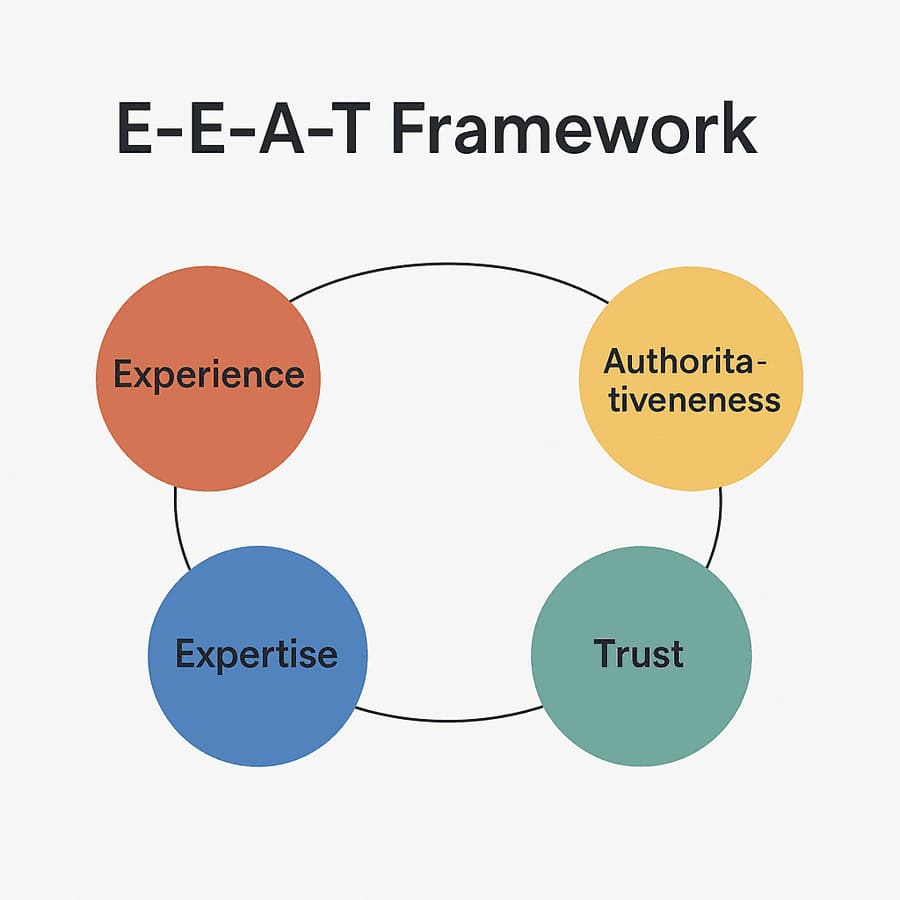
Google’s EEAT framework checks:
- Experience → Have you done this?
- Expertise → Do you understand the topic?
- Authoritativeness → Are you a reliable source?
- Trustworthiness → Check that the content is factual, transparent, and safe for readers.
AI speeds up drafting and research, but humans verify facts, add real-world experience, spot patterns, and make expert judgments. That’s why a human check is always required when publishing AI-generated content, especially if you want it to feel natural, experience-driven, and aligned with EEAT principles.
Why EEAT matters more for AI-supported content
Google now checks whether:
1. The content shows real experience.
Does the author have any experience, or has he used the methods he’s writing about?
2. Your understanding of the topic.
A human can provide deeper, experience-based explanations of the “why” behind an idea, while AI can explain concepts clearly but may not always match the depth, nuance, or context that comes from real-world experience.
3. You are a real person.
Author bio, profile links, and schema help Google to identify you.
4. The information is accurate and safe.
It can reduce visibility or treat it as spam under its policies. When your content mixes AI speed and human touch, you can get high EEAT. When AI speed is combined with human clarity and experience, EEAT becomes stronger.
How AI fits into an EEAT-driven workflow
AI helps me with:
- outline creation and keyword research
- draft expansion and structural editing
- simplify complex concepts for readers
- quick research and citation suggestions
- surface content duplication or clarity issues for review
But I never publish without reviewing every section myself.
Personal Experience:
When I first created long articles using AI, the draft looked complete but lacked depth. Some lines sounded robotic or unclear.
After editing manually, I understood that AI can give you a structure, but you can add an experience.
Applying the EEAT Guidelines to AI-Generated Content
E: Experience
Your personal experience is an important EEAT signal. You don’t need technical language. Only describe what you actually did and what you observed. This directly supports Trusted AI SEO by providing real-world proof that AI-assisted content is grounded in your actual experience, not just generated text.
Example:
When I scanned one of my drafts in Copyleaks, it highlighted repeated paragraphs I had not noticed. That’s when I realized how important duplicate-content detection is for long AI drafts.
E: Expertise
Expertise means you have in-depth knowledge of the topic, and you’re an expert in that subject and have enough experience to give reliable, practical guidance. I previously worked on projects where my role involved evaluating online content quality using various guidelines and EEAT principles. This helped me understand and gain the knowledge on how expertise, authority, and trust shape good content. This strengthens Trusted AI SEO by ensuring every AI-supported explanation is backed by expert knowledge your audience can trust.
Example:
If you’re a certified dancer, creating videos of dancing tutorials for kids using your own dancing knowledge and experience, then you’re demonstrating real expertise.
A: Authoritativeness
Authoritativeness is about being a reliable, trusted source, not a big brand. This builds Trusted AI SEO by showing Google and readers that your insights come from a credible, consistently reliable source.
My authoritativeness grew when my content consistently showed:
- clear explanations
- hands-on examples
- real insights
- honest feedback
Practical steps:
- Add a short author bio
- mention your experience
- link your LinkedIn
- publish trustworthy content consistently
- share knowledge across related topics
T: Trustworthiness
Trust comes from being honest, clear, and accurate. This reinforces Trusted AI SEO by making your AI-assisted content transparent, accurate, and safe for users.
Readers trust you when:
- Your identity is clear
- Information matches real use cases
- Examples are real
- Opinions are unbiased
- The tone is balanced
I avoid adding anything I cannot verify. A simple line such as: “AI assisted with drafting, and I manually checked and refined all content before publishing.” This can keep transparency as it is.
If you want a deeper explanation of how Google evaluates EEAT specifically for AI-written pages, see my detailed guide on E-E-A-T for AI Content.
3. Ethical Principles for AI Content
Ethical AI content respects users. It avoids deceptive information, stays transparent, and ensures accuracy.
Here are the four principles I follow:
1. Be Transparent About AI Use
A short disclosure is enough.
“This article was drafted with AI assistance and fully reviewed by me.”
It builds trust and protects you if the information later changes.
2. Human Editing Is Mandatory
AI writes quickly but cannot think like a human.
Your edits bring:
- clarity
- real logic
- tone consistency
- originality
I’ve seen AI-generated sentences that made no sense; that moment permanently reminded me why human editing is not optional.
3. Avoid Misleading or Incorrect Information
AI may:
- invent facts
- repeat ideas
- provide outdated details
If you cannot verify something → remove or rewrite it.
4. Respect Reader Trust
Ask:
“If beginners are following this advice, will it genuinely help them?”
That’s the most important part of ethical AI content. Don’t mislead users or generate any deceptive content only to make money.
Safe AI Use: Tools & Risk Control
AI adds speed and risk. A safe workflow prevents unclear, unsafe, biased, or inaccurate content. This is very important for YMYL topics.
Useful tools (with their purpose):
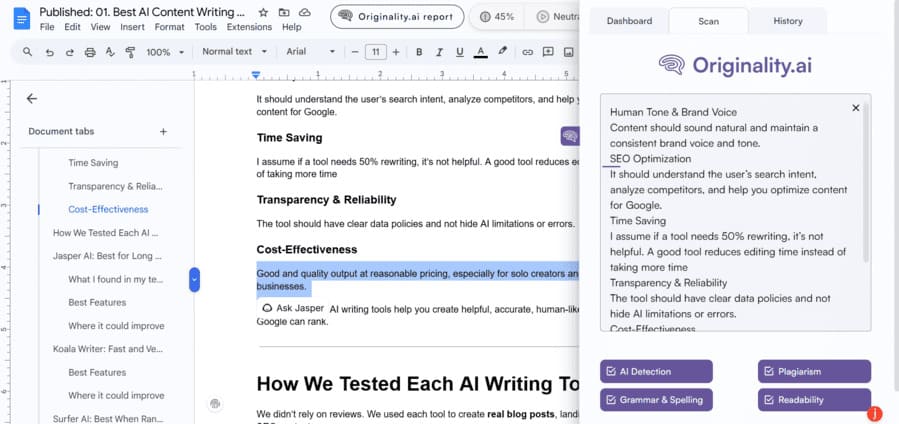
- Originality.ai: AI detection, plagiarism check, readability reports
- Copyleaks: duplicate text detection, plagiarism, hallucination patterns
- AIOSEO Analyze: readability, keyword usage, SEO suggestions
Your money, your life (YMYL) Safety Reminder
For legal, medical, financial, or mental-health topics, escalate unclear claims to a qualified professional before publishing.
A Trusted & Ethical AI Content Workflow (Expanded & Practical)
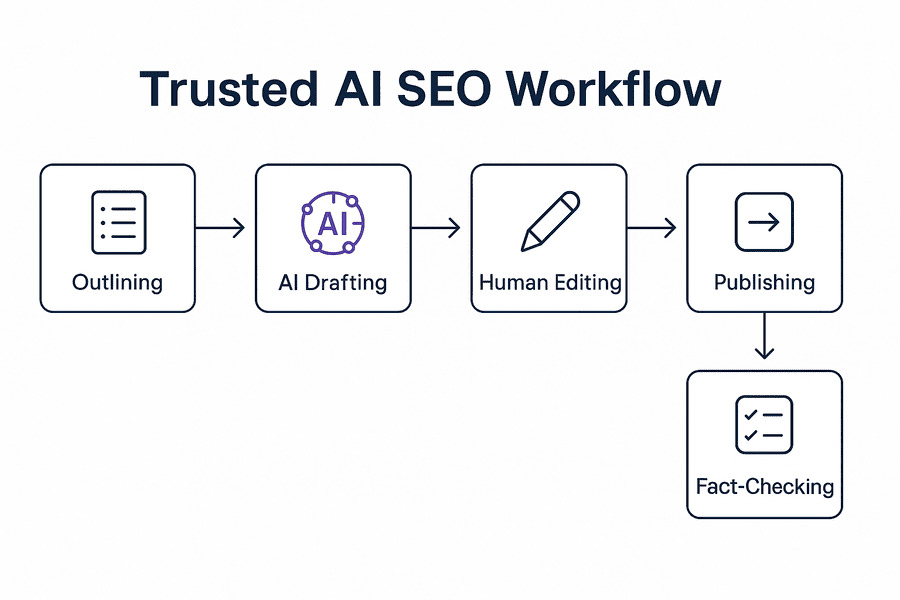
Step 1: Create an Outline Based on Search Intent
Ask:
- What is the user’s problem?
- What solutions are they looking for?
- What steps do they need?
- What questions do beginners have?
AI can structure, but direction should come from your understanding.
Step 2: Use AI to generate your first draft
Useful prompts are:
- Explain this clearly in simple words.
- Expand this without changing meaning.
- Give a clean outline for this topic.
Treat the draft as a base to start working on the final version.
Step 3: Run AI Accuracy Checks along with the Safety Before Editing
These early scans save time:
- unclear sections
- duplicated text
- hallucinations
- low readability
Tools: Originality.ai, Copyleaks, AIOSEO Analyze
If you want a structured evaluation process, follow a proper AI SEO strategy framework that includes a full EEAT-based audit before publishing.
Step 4: Add Your Experience & Insights
This is where EEAT becomes strong.
Example:
When I tested two AI tools on the same 1,500-word article, one wrote a clean outline but a very weak conclusion.
Since then, I have always rewritten conclusions myself; they require human judgment.
Step 5: Fact-Check Everything
Avoid invented:
- years
• statistics
• names
• processes
Replace with your own experience and verified facts.
Use neutral words when you aren’t fully certain.
Step 6: Quick Ethics & Compliance Check
Ensure:
- nothing can be misunderstood
- no confidential data
- advice is safe
- claims are reasonable and accurate
- tone is balanced
Step 7: Final Readability Edit
Improve:
- sentence length
- transitions
- clarity
- heading structure
- removal of repetition
Checking Bias, Hallucinations & High-Risk Information
AI can create mistakes or biased statements.
Your role:
- Rewrite overly general lines
- Verify uncertain facts
- Remove risky claims
- Add real examples
- Ensure neutral, balanced tone
Tools that check for bias or unclear wording can also help.
Building Credibility
Credibility grows when your identity is clear.
A strong author bio includes:
- your role
- experience
- your area of expertise
- LinkedIn profile link
Adding author schema helps Google understand who you are. Real screenshots, examples, or small wins serve as social proof.
Real Examples: How Trusted AI SEO Works in Practice
Example 1: Small Business Owner Blogging with AI
A small business owner used AI drafts but added:
- product usage insights
- customer questions
- personal experience
Result: Content became natural and started ranking for long-tail keywords.
This shows how Trusted AI SEO helps small businesses create helpful, trustworthy content with real experience added.
Example 2: SEO Consultant Writing Industry Guides
An SEO consultant used AI for outlines but added:
- real audits
- screenshots
- client’s mistakes and lessons learned
Result: Google rewarded the guides with better rankings because of strong EEAT.
This example demonstrates how Trusted AI SEO strengthens depth, clarity, and trust through expert-led insights.
Example 3: Content Creator Using AI for Educational Material
A content creator who makes educational tutorials used AI to speed up lesson outlines. But instead of publishing directly, she added:
- her teaching examples
- real class feedback
- student mistakes
- her own experience
Result: The content performed better because it had accuracy, relatable examples, and strong EEAT, something pure AI content cannot replicate.
This shows how Trusted AI SEO improves learning content by combining AI structure with human teaching experience.
Final Checks Before Publishing: The Trust Checklist
 Readability Check
short, clear sentences
short paragraphs
natural flow
Flow & Structure Check
correct H2/H3 hierarchy
smooth transitions
logical order
EEAT Check
personal experience added
author bio present
accuracy verified
plagiarism-free
Trust & Transparency Check
no outdated claims
no unsafe suggestions
neutral tone
balanced perspective
SEO Optimization Check
primary keyword used naturally
clean heading structure
metadata ready
alt texts keyword-aligned
internal links added
These checklists complement my step-by-step AI SEO best practices guide, where I explain exactly how to optimize AI-generated content for Google without sacrificing quality or trust.
For further, deeper quality through the bundle of free guides and checklists:
- AI-Ready Content Quality Playbook (2025)
- AI Content Quality Checklist (Printable)
- AI Writing Tool Selection Checklist
Download free AI content quality resources to support ethical, EEAT-aligned AI publishing.
FAQ:
Q: Is AI-generated content allowed by Google?
A: Yes, Google allows AI-generated content as long as it meets quality standards and is reviewed by a human. The focus is on EEAT and trust, not who wrote the first draft.
I’ve also explained this in detail in Does Google penalize AI content?, based entirely on Google’s own documentation.
Q: What is ‘Trusted AI SEO’?
A: Trusted AI SEO is the practice of using AI for drafting while keeping the accuracy, depth, and decision-making fully human-guided. It prioritizes EEAT, safety, transparency, and user trust.
Q: How do I disclose AI use in my articles?
A: Use a simple, honest line such as: “This article was drafted with AI assistance and reviewed by me for accuracy and clarity.” This strengthens your trust signals without affecting rankings.
Q: How do I stop AI from hallucinating or giving wrong facts?
A: Use a safety workflow: draft → human review → fact-check → scan with tools like Originality.ai or Copyleaks → final edit. Remove anything that cannot be verified.
Q: Does AI content need to pass plagiarism or AI detection tools
A: No tool is required by Google. These tools are only for quality control. What matters is: human review, originality, helpfulness, and accuracy.
Q: Does adding my personal experience improve SEO?
A: Yes. Google strongly rewards real experience because AI alone cannot recreate lived examples or real results. Even simple experiences count.
Q: How do I make AI-written articles safe for YMYL topics?
A: Escalate unclear advice to a qualified expert, avoid strong claims, verify facts, and maintain a balanced tone.
Q: What tools should I use for Trusted AI SEO workflows?
A: Originality.ai → AI + plagiarism + readability, Copyleaks → duplication + hallucination patterns, AIOSEO Analyze → readability + keyword usage
Q: Can AI help me create an SEO content workflow?
A: Yes, AI can speed up outlines and drafts, but human judgment is required for experience, examples, conclusions, safety, and corrections.
With the full workflow covered, here’s the key takeaway:
Final Conclusion
Trust is what makes content valuable. You have to build trust first and then use AI second. Google’s systems tend to rank content higher when it demonstrates strong E‑E‑A‑T.
Google’s systems are designed to prioritize helpful, reliable, people‑first content that shows strong E‑E‑A‑T, which usually includes careful human review and depth.
When AI speed is combined with your expertise, you create content that stands out and ranks higher.
Trusted AI SEO is the foundation of long-term content success in 2026 and beyond.