

Introduction:
This guide explains how to choose an AI writing tool by evaluating accuracy, tone control, long-form stability, rewriting ability, workflows, SEO features, and real value. These insights come from testing 20+ tools in real publishing workflows.
Choosing the right AI writing tool can feel more challenging than writing the content itself. Every tool claims to be the best. Every website has its own ranking, and every marketer makes big promises. But after testing 20+ AI tools for real SEO articles, rewriting, and client projects, I learned one thing:
The right AI writing tool depends on your workflow, not hype, features, or popularity.
This guide will help you understand how to choose the right AI writing tool with no confusion, save time, reduce frustration, and avoid wasting money on tools that don’t support your workflow.
How to Choose the Right AI Writing Tool (Key Factors)
People often assume all tools are the same, but once you start publishing content, the differences become very clear.
Here’s what I noticed while testing tools for real work:
- Some tools create great ideas but struggle with long-form content.
- Rewrite tools like Quillbot shine at polishing sentences, but can’t write whole articles.
- Many free AI writing tools break when accuracy or SEO is required.
- Older-model tools sound robotic and overly generic.
- Some platforms are templates wrapped around outdated models.
How to Choose an AI Writing Tool: The 7 Criteria I Use
After years of testing, these are the factors that actually matter, not the marketing claims.
Accuracy & Hallucination Control
Accuracy is critical.
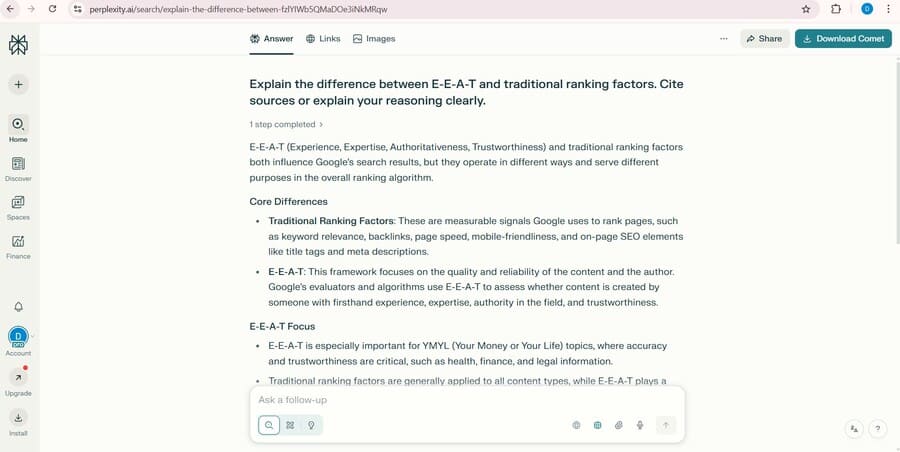
Google has clearly stated that content quality matters more than whether AI was used, as long as the content is accurate and helpful, as explained in Google Search Central’s guidance on AI-generated content. In fact, most older AI models show 2–3× higher hallucination rates in factual topics.
How I test accuracy:
- Ask the tool to explain its reasoning
- Check if it invents stats or sources
- Give it factual topics
- Check if it writes confidently wrong answers
Modern models generally perform far better than older ones. For a deeper breakdown of accuracy, trust signals, and ethical AI use, read my full guide on Trusted AI SEO Foundations.
Mini Summary:
If accuracy matters (SEO, tutorials, reviews), avoid free or outdated tools.
Tone Control & Human-Like Writing
A good AI writing tool should sound like you, not robotic, and not overly casual.
Testing insights:
- Jasper AI is strong with brand voice, but it can sound too promotional.
- Quillbot rewrites cleanly, but tone consistency isn’t perfect.
- Free AI tools are repetitive and monotonous.
If you regularly publish blogs, guides, or educational content, tone control is essential.
Mini Summary:
Choose a tool that matches your tone and reduces editing, not one that creates more work.
Long-Form Stability (Critical)
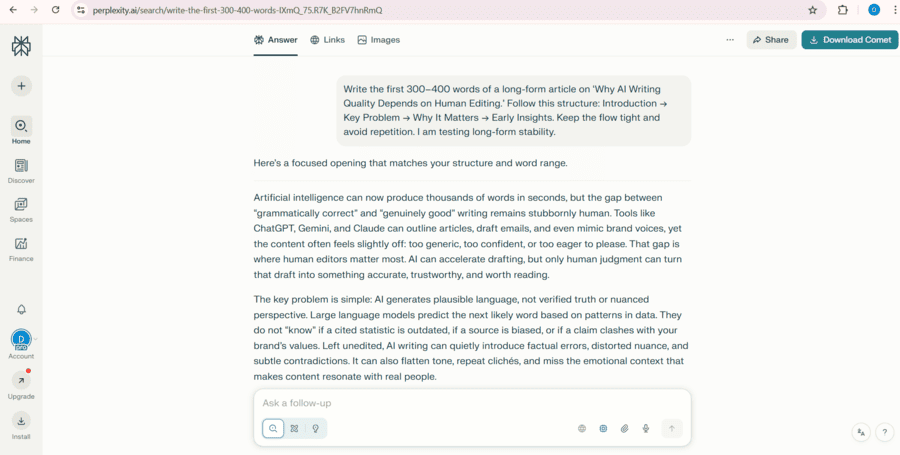
Many tools can write short paragraphs, but only some maintain structure over 1,200–3,000 words.
A big part of how to choose the right AI writing tool is checking whether it can hold a long-form structure.
What I test:
- Sections must flow logically
- No repetition after 800–1,000 words
- It follows the brief
- It references earlier parts of the draft
Rewriting Ability
If rewriting is part of your workflow, this becomes a major decision factor in choosing the right AI writing tool.
My findings:
- For rewriting, Quillbot performs best.
- Some tools rewrite too heavily and distort meaning.
- Some rewrite too lightly and keep errors.
- Some fail to maintain tone alignment.
Mini Summary:
For rewriting, Quillbot outperforms most general AI writing tools.
SEO Features & Optimization Support
Not all tools handle SEO well, even if they offer “SEO features.”
What I test:
- Does it understand keyword relationships?
- Does it improve structure?
- Does it consider search intent?
- Can it pair with SEO optimization tools?
- Is keyword density natural?
Most basic AI tools count keywords, but SEO is more than that.
For a deeper breakdown of SEO-friendly tools, read my full guide: Best AI Content Writing Tools in 2026.
Mini Summary:
If SEO matters, pair your writing tool with AI content optimizer tools.
Templates, Workflows & Custom Instructions
Templates are basic, but workflows create real consistency.
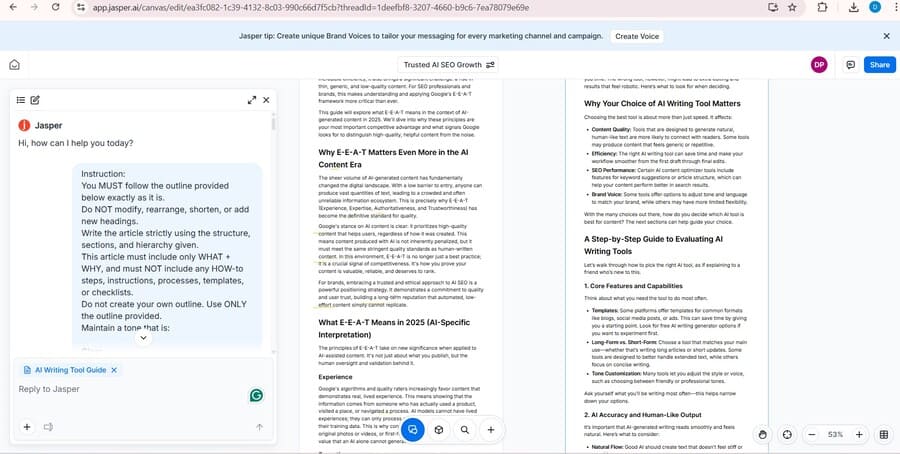
What I test:
- Can I save my instructions, brand voice, and tone?
- Does the tool follow my format every time?
- Can I build repeatable workflows?
- Does it support memory accurately?
Tools like Jasper AI have strong workflows. Rewrite tools like Quillbot do not.
Mini Summary:
If you publish regularly, choose a tool with reusable instructions.
Pricing vs Real Value
Pricing varies, but a higher price doesn’t mean a better tool.
What I look at:
- Does it save editing time?
- Does it reduce rewriting?
- Are essential features available without upgrades?
- Does it offer real value for SEO content?
Free tools can look appealing, but often cost more time in editing.
Mini Summary:
Pay for tools that reduce workload and improve output quality.
5 AI Writing Tool Categories (Choose Based on Use Case)
Understanding these categories makes it easier to choose the right AI writing tool for your workflow.
1. Marketing-Focused Tools (e.g., Jasper AI)
Best for: Social posts, landing pages, ads
Pros: Templates, brand voice memory
Cons: Sometimes too promotional
2. Rewriting Tools (e.g., Quillbot)
Best for: Rewriting, polishing, paraphrasing
Pros: Clean rewrites
Cons: Not ideal for new long-form content
3. Free AI Writing Generators
Best for: Fast ideas, simple drafts
Pros: Free and accessible
Cons: Weak for SEO, inconsistent accuracy
4. SEO Optimizer Tools
(Not writing tools; they support writing tools.)
Best for: Improving ranking and content structure
Cons: Must be paired with a writing tool
5. Long-Form Writing Tools
Best for: Guides, manuals, ebooks
Pros: Memory, outline tools
Cons: Some repetition or loss of structure in long drafts
The 3-Step Method to Choose Your AI Writing Tool
This simple method helps you quickly understand how to choose the right AI writing tool for your own workflow.
Step 1: Identify Your MAIN Purpose
Choose only one:
- Long-form content
- Rewriting
- Books or guides
- Social content
- Everyday writing
- SEO optimization
Step 2: Match Use Case → Tool Category
- Rewriting → Quillbot
- SEO Optimization → AI optimizer tools
- Long-form → memory-based writing tools
- Marketing → brand voice tools
- Free → idea generation only
Step 3: Test ONE Real Article
Not a sample prompt; a real article.
Questions to evaluate:
- Did it follow my brief and maintain tone?
- Did it hallucinate?
- Did it repeat information?
- Did it reduce editing time?
FAQs:
1. What’s the best way to choose an AI writing tool that actually fits my workflow?
Choose based on your main use case: rewriting, SEO content, long-form guides, or marketing copy. Then test one real article to see whether the tool follows your brief and reduces editing time.
2. Which AI writing tool is best for long-form content?
Tools built on modern models usually handle long-form structure better. Free tools may repeat or lose structure, so expect more editing.
3. What is the best AI tool to rewrite content?
Quillbot consistently performs best for rewriting due to meaning preservation and clarity.
4. Do free AI writing generators work?
They work for simple drafts and ideas, but are not ideal for SEO-focused or accuracy-sensitive content.
5. Which AI tool is best for content writing overall?
There is no single best tool; choose the one that fits your workflow and reduces editing time.
Final Takeaway:
The best AI writing tool is the one that fits your workflow, produces reliable drafts, and reduces editing time.