
Introduction: Why the Fear Around AI Content Exists
Since tools like ChatGPT became mainstream, one question has dominated SEO discussions:
“Does Google penalize AI content?”
The fear didn’t come from nowhere. AI detectors, viral claims about “Google cracking down,” and frequent algorithm updates have made many site owners worry that using AI could quietly hurt rankings. Many publishers fear that a single misused AI workflow could undermine their search visibility.
But most of this anxiety comes from confusion, not policy.
Two ideas are often mixed up:
- AI detection ≠ penalty
- Automation ≠ spam
Google’s position has been consistent for years, even if it’s often misunderstood.
Google does not apply penalties based solely on whether content is created with AI. It penalizes content that is unhelpful, manipulative, or created primarily to game search results — regardless of how it’s produced.
This article breaks down what Google says in Search Central documentation and explains how AI-assisted content is evaluated in practice.
Short Answer: Does Google Penalize AI Content?
No. Google does not penalize content just because it is AI-generated.
Here’s the clear breakdown:
- ❌ No automatic penalty for AI-generated content
- ✅ Google evaluates helpfulness, relevance, and people-first value
- ⚠️ Enforcement happens only when spam policies are violated
What Google Means by “Penalty” (Important)
When people search “does Google penalize AI content,” they usually mean one of three things:
- Manual action: A human reviewer applies a manual action when clear spam policy violations are found (rare).
- Ranking decline (algorithmic systems): Reduced visibility because content fails quality or helpfulness signals (common).
- Removal or demotion due to spam policy violations: This can occur when content is considered manipulative or unhelpful at scale.
In many cases, AI-assisted content that loses rankings is affected by quality evaluation, not punitive enforcement.
Myth vs Reality: Clearing the Biggest Confusion
Myth: Google has an AI detector and penalizes AI-written text.
Reality: Google has systems designed to fight spam and unhelpful content. Recognition of automation does not equal punishment. Automation is acceptable when the content is useful and not created to manipulate rankings.
The real risk isn’t AI; it’s publishing without judgment.
Google’s systems don’t reward content based on how it’s created, but on whether it genuinely helps users and demonstrates editorial care.
Google’s Policy Map: Where AI Content Actually Fits
Understanding Google’s stance is easier when you separate four different systems that are often blended together.
1️⃣ AI / Automation Guidance
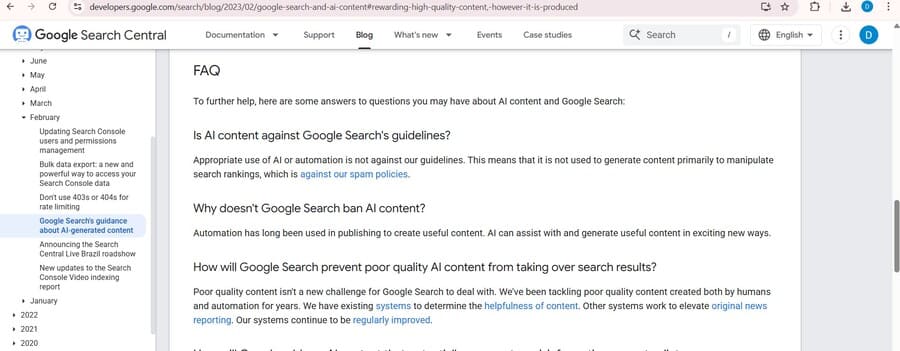
Google explicitly states that using AI or automation is not against its guidelines when it’s not used primarily to manipulate rankings.
For more practical context on how Google views generative AI specifically, see Using generative AI content (Google Search Central documentation).
“Appropriate use of AI or automation is not against our guidelines.”
— Google Search Central, Google Search and AI-generated content
2️⃣ Spam Policies (Including Scaled Content Abuse)
Spam policies cover practices like scaled content abuse, creating many pages primarily to manipulate rankings rather than help users.
“Using automation to generate content primarily to manipulate search rankings may be considered spam.”
— Google Search Central, Spam policies
This is where manual actions or ranking impacts can occur — regardless of whether content is created by humans, AI, or automation.
3️⃣ Ranking Systems
Google’s ranking systems focus on helpfulness, relevance, and people-first value, not the tool used to create content.
Google explains this principle in Google’s guidance on creating helpful content.
Low-quality content ranks lower, no matter how it’s produced.
4️⃣ Quality Rater Guidelines (E-E-A-T)
The Quality Rater Guidelines introduce E-E-A-T (Experience, Expertise, Authoritativeness, Trustworthiness).
“The Quality Rater Guidelines are used to assess how well our systems are working. They do not directly influence ranking.”
— Google Search Central, Quality Rater Guidelines
They explain what quality looks like, not how to trigger rankings.
What Google Officially Says About AI-Generated Content
Google’s core principle is consistent:
“Our focus on the quality of content, rather than how content is produced, is a useful guide that has helped us deliver reliable, high-quality results to users for years.”
— Google Search Central, Google Search and AI-generated content
This is why AI is treated as a tool, not a violation.
What matters most is why the content exists and whether it genuinely helps users.
Automation Is Allowed; Manipulation Is Not
Google does not publish a list of “approved AI tasks.”
Instead, everything is framed around intent.
Automation crosses the line only when it’s used mainly to influence rankings rather than help users.
Problematic patterns include:
- Mass-produced pages with no added value
- Keyword-targeted content created only to rank
- Large-scale publishing without editorial review
Acceptable AI-assisted publishing looks like:
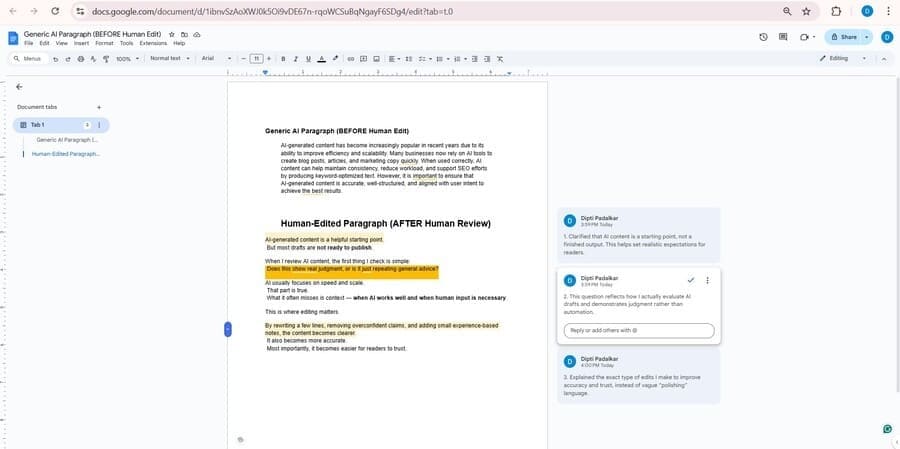
- AI drafts reviewed and edited by humans
- Original insight layered on top of AI output
- Clear people-first intent
Can Google Detect AI-Generated Content? (And Why That’s the Wrong Question)
A better question than “Can Google detect AI?” is:
“What does Google actually act on?”
Google has systems designed to fight:
- Spam
- Low-quality automation
- Manipulative publishing patterns
Detection alone does not cause ranking drops.
What matters are signals such as:
- Thin or repetitive content
- Over-templated structure
- Lack of original value
- Pages that feel mass-produced
Key clarification:
AI-related patterns may be detected, but AI use alone doesn’t trigger enforcement. Quality and intent signals drive evaluation.
Detection vs Evaluation vs Enforcement (1-Minute Model)
This simple model explains where confusion usually happens:
- Detection
Systems may identify patterns or behaviors associated with low-quality or manipulative content. - Evaluation
Ranking systems weigh usefulness, relevance, and people-first value to determine visibility. - Enforcement
Spam policy violations can lead to manual actions or ranking impacts.
Google may take action when content violates spam policies or seems primarily created to manipulate rankings; AI use alone isn’t the point—value to users is.
What Actually Causes Ranking Drops on AI-Assisted Pages?
When AI-assisted pages lose rankings, it’s usually due to content quality issues, not AI usage itself.
Common causes include:
- Thin coverage — topics mentioned but not fully explained
- No original information — pure SERP rewrites
- Incorrect or outdated facts — hallucinations not caught in review
- Templated pages at scale — same structure across many URLs
- Search intent mismatch — content doesn’t satisfy user needs
These issues affect human-written pages too — AI just makes them easier to produce at scale if unchecked.
Does AI Content Affect SEO Rankings?
There is no direct ranking demotion for AI content.
AI-assisted content underperforms only when it fails quality standards.
Pages tend to struggle when they:
- Add no new insight
- Feel generic or unsatisfying
- Don’t fully answer user intent
Underperforming AI content is usually outranked, not punished.
The Helpful Content System: How Google Actually Evaluates Content
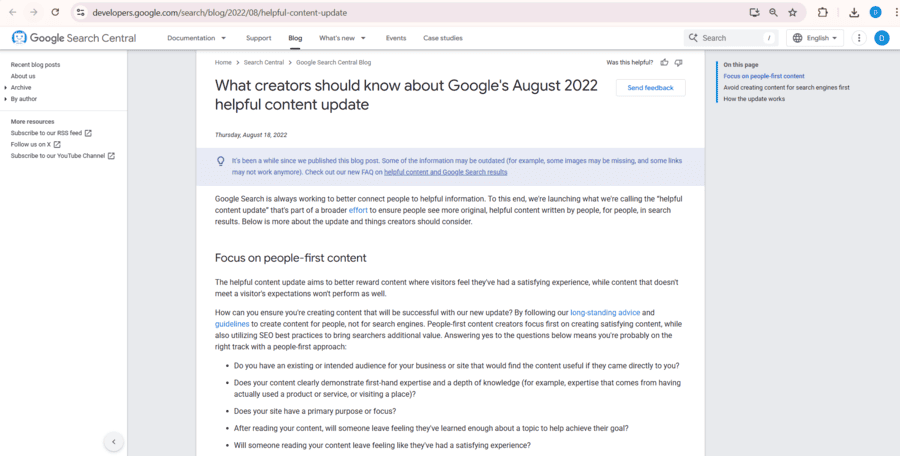
The Helpful Content System is not an AI filter.
“The helpful content system aims to better reward content created for people, and to reduce the visibility of content that seems primarily created for search engines.”
— Google Search Central, Helpful Content Update
It evaluates:
- Depth and completeness
- Intent satisfaction
- Structure and clarity
AI can be used to create helpful content, but using generative AI at scale without adding value can violate Google’s spam policies.
Decision Tree: Should You Publish This AI-Assisted Content?
Before publishing, ask:
- Is this genuinely helpful to a real user?
- Does it add original insight or experience?
- Was it created mainly to help users, not just rank?
- Has it been reviewed by a qualified human?
If any answer is “no,” don’t publish yet.
E-E-A-T for AI Content: How Trust Is Proven
E-E-A-T applies to all content, including AI-assisted work.
AI can draft text.
Proof can come from verifiable first‑hand experience, authoritative sources, data, or transparent editorial processes, not only human testimony.
On my own site, AI-assisted articles that went live without editorial depth consistently underperformed those reviewed and expanded with first-hand insights.
If you want a deeper implementation guide, see E-E-A-T for AI Content.
E-E-A-T Trust Proof Checklist (Operational)
- Author & Responsibility
Author page with relevant experience; clear responsibility statement - Editorial Policy
How AI is used (drafting vs final); review and fact-checking steps - Citations & Updates
Primary sources; update dates and change-log - First-Hand Experience
Screenshots, tests, data, examples - Transparency
“Who / How / Why” disclosure where appropriate
AI assists. Humans validate. Proof builds trust.

How to Audit an AI Content Library (30-Minute Checklist)
- 10 minutes — Coverage
Does each page fully answer its main query? - 10 minutes — Originality
Is real insight or experience added? - 5 minutes — Accuracy
Verify key facts and claims. - 5 minutes — Intent
Does the page match what users want?
Pages failing multiple checks should be updated, merged, or improved, not deleted blindly.
How to Use AI Content Safely (High-Level)
- Use AI as a drafting assistant, not the final authority
- Add experience, verification, and examples
- Apply editorial review before publishing
- Avoid mass publishing without QA
For a practical workflow, read How to Optimize AI Content for Google.
FAQs
Is AI content OK for SEO?
Yes. Google evaluates content quality, not the tool used.
Can Google detect AI-generated content?
Google fights spam and low-quality automation; detection alone isn’t a penalty.
Does AI content affect rankings?
Only indirectly, when it fails helpfulness signals.
Does Google penalize websites using AI?
Only when spam policies are violated.
Do I need to disclose AI use?
Not required for rankings, but transparency can improve trust.
Final Takeaway
Google doesn’t punish AI.
It rewards helpful, original, people-first content.
The real question isn’t:
“Does Google penalize AI content?”
It’s:
“Is this content genuinely worth ranking?”
Sources: Official Google Documentation
- AI / Automation Guidance section
Google Search and AI-generated content (Search Central) - Spam Policies section
Spam policies for Google Web Search - Helpful Content System section
Helpful Content Update (Google Search Central) - E-E-A-T / QRG section
Quality Rater Guidelines & E-E-A-T (Google Search Central)