

Introduction: Why AI-Generated Content Needs Smarter Google Optimization
If you use AI tools for writing, you’ve likely had the same thought I did: AI is fast, but Google won’t rank content that feels AI-written.
This guide shows how to optimize AI content for Google using real examples, checklists, and trust-focused SEO practices.
When I first used AI drafts in my blogs, the results surprised me. Some posts ranked quickly, and others got almost no impressions.
The niche was the same, and the tool was the same. The only difference was how well the draft was optimized for Google’s new AI search.
To optimize AI-generated content for Google, you have to refine the raw draft with verified facts, personal experience, clean structure, and strong E-E-A-T signals. This process turns typical or you can say, generic AI text into authoritative content that Google can trust. In short, it’s how you make AI-assisted writing competitive in real search results.
Google isn’t against AI. It’s against low-quality, generic, and unverified AI text.
This guide shows you exactly how I transform raw AI drafts into content that is:
- Accurate
- Experience-backed
- Well-structured
- AI Overview ready
- And genuinely helpful
Let’s turn your AI drafts into content Google actually trusts.
Quick Summary
- Google doesn’t rank AI content based on how it’s written, but on quality, trust, and usefulness.
- High-performing AI-assisted content combines human review, verified facts, and real experience.
- Clear structure (H2/H3 headings, short paragraphs, bullet points) helps both readers and AI Overviews.
- Strong E-E-A-T signals—author identity, examples, and citations—are essential in 2026.
- A simple system—audit → improve → structure → optimize → refresh—is enough to make AI content competitive.
What Google Actually Wants From AI-Generated Content
Google has been clear:
They don’t care who writes the content; they care whether it’s helpful.
Based on everything I’ve tested, tracked, and repaired inside real websites, here’s what matters most in 2026.
Google’s Updated Stance on AI Content
Here’s the short version:
- AI content is allowed
- Low-quality AI content is not allowed
Google downgrades content showing patterns like:
- Unnatural sentences
- No personal experience
- Unverified claims
- No E-E-A-T
- Missing original insights
If Google detects these, your page sinks, sometimes instantly.
Google has also confirmed in their official guidance on AI-generated content that it is perfectly acceptable as long as it meets their people-first quality standards, not low-value or unhelpful text.
The 4 Pillars of Optimization AI content for Google
After optimizing many of the AI articles, these four factors consistently determine ranking:
1) Accuracy & Fact-Checking
I’ve caught wrong stats more times than I can count. One wrong number can hurt the whole article.
AI also gives outdated stats, especially in marketing and technology.
After one article underperformed, I realized how a small mistake can hurt trust.
Now I do a quick accuracy check for every draft. For statistics or product claims, I cross-verify them with at least two sources, and if I can’t confirm a number within 5–10 minutes, I either remove it or reframe it as an estimate.
2) Strong E-E-A-T Signals
I always add:
- Author name
- Real examples
- Mini-stories like, “When I tested this…”
- Sources or citations
These instantly raise trust. For a deeper breakdown of how I apply trust, ethics, and E-E-A-T principles to AI-assisted content, see Trusted AI SEO Foundations.
3) Structure Designed for LLMs
Large language models power search today. They prefer:
- Short paragraphs
- Scannable H2 → H3 structure
- Bullet lists
- Clear hierarchy
- Direct answers
This is where human editing beats AI.
4) Human Oversight
My ratio is usually:
70% AI → 30% Human refinement.
That last 30% is where rankings come from.
When I updated some of my older AI-written articles by adding real examples and a clearer structure, they started getting impressions again within a week. The improvement wasn’t from new keywords; it was the added human insight.
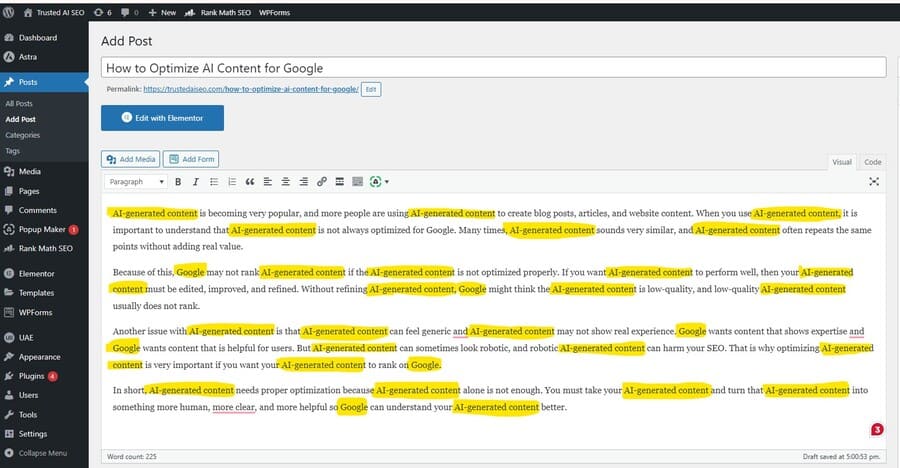
Signs of Low-Quality Content
From my testing and Google’s guidelines:
- Too common intros
- Over-explanation of simple concepts
- Repetitive and particular sentence patterns
- No examples or POV
- Long paragraphs
- Claims and stats without verification
If I find even 2–3 of these, I rewrite before publishing.
Google reinforces this in their official Helpful Content Guidelines, where they explain that low-value, unhelpful, or shallow content, regardless of whether it’s written by a human or AI, may not perform well in Search.
Search Intent & Keyword Strategy
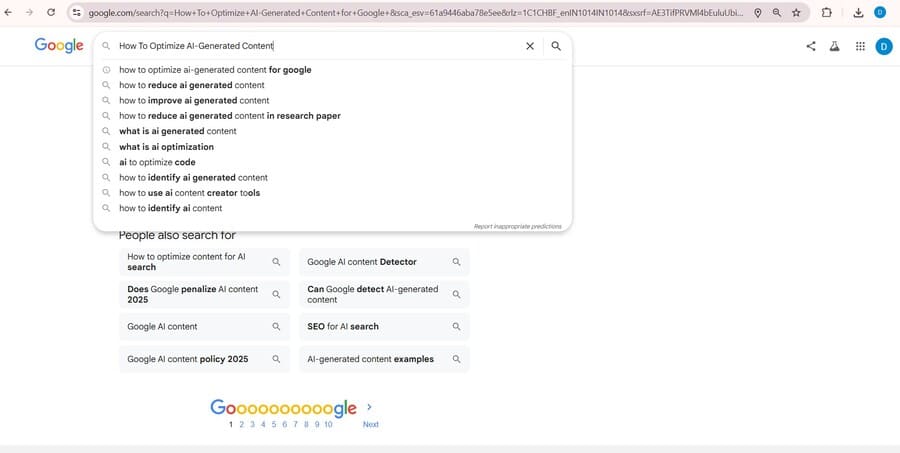
Even good content can fail if it doesn’t match search intent.
From my own testing, the biggest ranking gains didn’t come from adding more keywords. They came from aligning the content with how people actually search and how relevant the content is. When I aligned intent first instead of keywords, impressions stabilized faster after updates.
Matching Content to Real User Intent
Before writing or editing, I look at intent from three angles:
Informational intent
People are searching for things like how to optimize AI-generated content, checklists, or step-by-step guides.
This article is written mainly for this intent.
Transactional intent
Users are looking for tools, comparisons, or recommendations, such as the best AI content writing tools.
These fit naturally inside examples and supporting sections.
Mixed intent
Searches that combine learning and tools, like how to optimize AI content and which tools help.
These often perform well in AI Overviews because they solve more than one need at once.
Cover the topic fully, without forcing keywords
Instead of chasing one keyword, I focus on covering the full topic naturally.
Core phrases appear where they make sense. Tool-related terms show up inside real examples. Quality-focused language is supported through audits, checklists, and experience-based explanations. This reflects how people search and helps Google understand relevance, without repetition or keyword stuffing.
This means:
- The main keyword fits naturally in the headline
- Variations appear early in the introduction
- Related terms are spread across sections
- Intent-based phrases show up in examples and FAQs
I don’t force exact wording. I write around real search questions, explain them in plain language, and refine phrasing during edits to avoid repetition. The result is content that feels natural to read while still being clear and discoverable for search engines.
Step-by-Step Framework: How I Optimize AI-Generated Content for Google
This is where most people struggle, not with writing the draft, but with turning it into something Google can trust.
This is the same process I use to optimize AI-generated content on my own or client sites.
I follow a simple three-phase process.
Run an Audit (My Personal Checklist)
Before making improvements, I often follow structured AI SEO optimization steps to systematically evaluate quality, accuracy, and E-E-A-T signals.
Here’s what I look for:
A. Generic AI phrasing
“In today’s digital world…”
“In conclusion…”
“AI is rapidly changing…”
These get deleted instantly.
B. Unverifiable claims
If AI states a fact, I verify it using Google, Perplexity, and Originality AI.
C. Repetition
If two sections sound the same or repeat the same details, I merge or rewrite.
D. Missing human experience
Anytime I add a small personal experience, even just a sentence about what I tested, the article instantly feels more trustworthy. I’ve noticed these sections get picked up more often in Featured Snippets and AI Overviews.
I add lines like:” When I tested this” or “Here’s what surprised me.”
Even one short line based on actual use is enough. For example, when testing AI-written comparison pages, I noticed that adding a single sentence about why I rejected one tool often improved engagement more than adding another feature list.
E. Missing examples/screenshots
Google tends to reward content that clearly demonstrates the process behind it.
F. No expertise markers
If it reads like a generic AI textbook, it won’t rank.
Improve the Draft With Human-Added Value
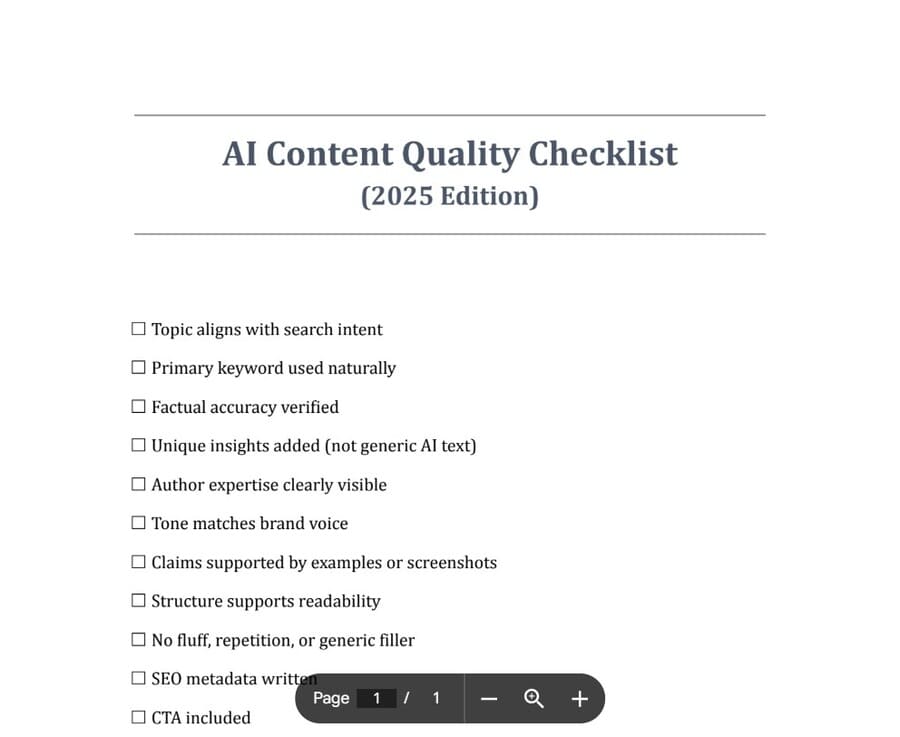
This is where the magic happens.
Here’s how I improve each section:
✔ Add real examples
✔ Insert mini-stories (“Here’s what happened when I tried this…”)
✔ Add POV or opinion
✔ Expand shallow AI summaries
✔ Add verified stats
✔ Add internal links to build topical authority
Add E-E-A-T Signals (Non-Negotiable)
Google wants to know:
- Who wrote this?
- Why should we trust them?
I add:
- Author credentials (1–2 lines)
- Experience paragraphs like, “When I used this during publishing.”
- Citations and transparency
- Reviewed by line (optional)
Structure Your Content for AI Overviews (SGE) & LLMs
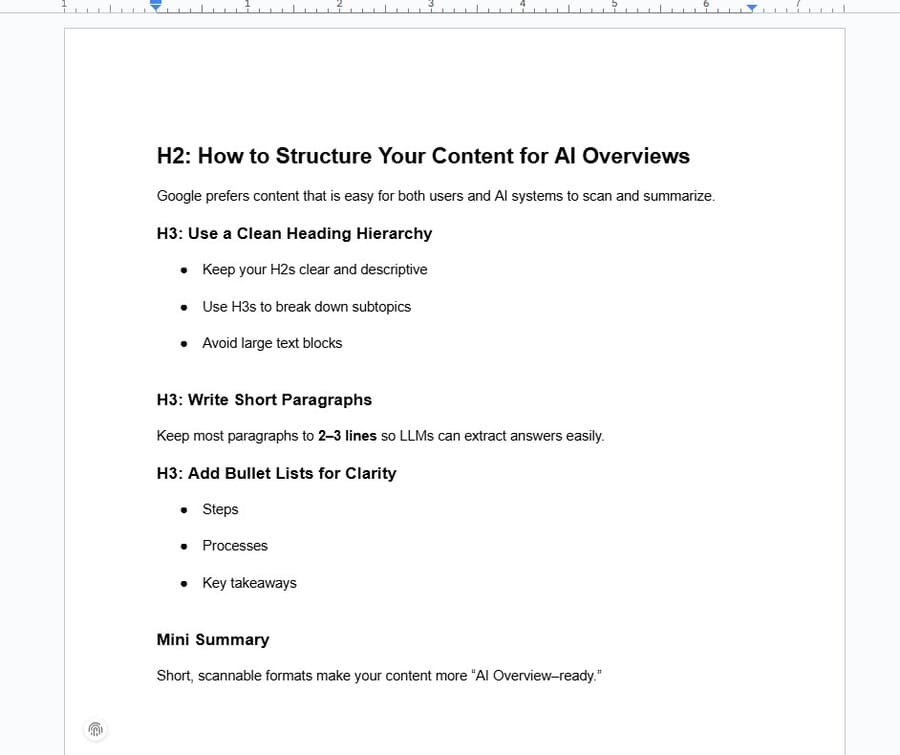
AI Overviews tend to surface content that is scannable, clearly structured, and backed by real experience.
✔ Clean H1 → H2 → H3 hierarchy
✔ Direct answer at the top
✔ Short 2–3 sentence paragraphs
✔ Bullet lists
✔ PAA-style FAQs
✔ Mini-summaries under each major section
This makes your content “AI Overview ready.”
Technical SEO + Schema Setup
This takes 5 minutes:
- Article schema
- FAQ schema
- Meta title + description
- Internal linking
- Optimized alt text
- Clean image metadata
Tools I use: RankMath, Yoast, Schema Markup Generator.
Refresh Your AI Content Every 30–45 Days
Every month, I update:
✔ Stats
✔ Outdated tools
✔ Examples
✔ FAQs
✔ Screenshots
For AI tool review pages specifically, I do a deeper refresh every 90 days. This includes re-checking pricing pages, feature availability, UI changes, and whether the tool still matches the use cases I originally recommended. Tool content goes stale faster than guides, so I treat it differently.
Content freshness is an important relevance factor, especially in fast‑moving topics like AI and SEO.
Real Before–After Examples of Optimized AI Content
Here are quick transformations that improved my rankings.
Example 1: Removing Generic AI Phrasing
Before:
“AI content writing is becoming very important…”
After:
“When I tested AI drafts across real blogs, I noticed Google ignores anything that sounds like an AI brochure…”
Why it works: Adds specificity and human experience, which increases trust.
Example 2: Adding Missing E-E-A-T
Before:
“Fact-checking is important.”
After:
I’ve caught hallucinated stats while using AI, especially outdated numbers. Before publishing, I verify every claim using Perplexity or government sources.
Why it works: Demonstrates real verification and firsthand use, not theory.
Example 3: Structuring Content for AI Overviews
Before:
Long, unbroken paragraph.
After:
Short paragraphs, bullet steps, clear H2–H3 headings, and a direct answer block.
Why it works: Improves scannability and helps AI systems extract clear answers.
Tool Stack: Best Tools to Optimize AI-Generated Content
These are the tools I actually use or evaluate when refining AI-generated content for accuracy, structure, and search visibility.
SEO Content Optimization Tools
- Surfer SEO
- Frase
- NeuronWriter
- Clearscope
If you’re unsure which tool fits your workflow, this guide on How to Choose the Right AI Writing Tool breaks down the differences without overwhelming you.
Tools for AI Overview Visibility
Tools focused on prompt alignment and AI-generated search summaries:
- RankPrompt
- Profound
Fact-Checking Tools
- Perplexity
- ScholarAI
- Google Scholar
Compliance & Transparency Tools
- Plagiarism checkers
- Citation validators
- Tone editors (Hemingway, Grammarly)
Complete Checklist: Optimize AI Content for Google
This is the condensed version of the exact process I follow before publishing:
Content Quality: Search intent, natural keywords, examples, insights
Accuracy: Verified stats, citations, no hallucinations
E-E-A-T: Author info, POV, testing insights
Readability: Direct answer, headings, short paragraphs, bullets
Technical SEO: Meta data, schema, internal links, alt text
Monitoring: AI Overview visibility, freshness updates
If you want the full structured version, refer to the detailed AI content review checklist I use before publishing any AI-assisted article.
Common Mistakes to Avoid
- Writing for AI tools instead of humans
- Over-optimizing keyword density
- Publishing without human editing
- No fact-checking
- No author identity
- No internal links
- Long paragraphs
- Not refreshing content
If your traffic has already declined due to low-quality or misaligned AI content, a structured Google traffic drop recovery consultation can help identify the root cause before rankings fall further.
Final Tips: Stay Ahead in AI + Google Search
- Refresh every 30–45 days
- Add personal insights
- Use AI for speed, not final drafts
- Build topic authority with strategic internal linking
- Keep screenshots updated
Conclusion
AI isn’t the problem, but low-quality AI content is.
The content that ranks in 2026 is helpful, clear, experience-driven, and well-structured. It’s also optimized for how AI Overviews work.
Not every AI draft needs a full rewrite.
You just need a system: audit → improve → structure → optimize → refresh.
Follow the checklist in this guide, and your AI-generated content will feel human, trustworthy, and aligned with what Google actually rewards.
FAQs
- How do I optimize AI-generated content for Google?
Audit the AI draft for generic phrasing, missing experience, and unverified claims; add your own examples, insights, and verified data; then structure it with clear H2/H3 headings, short paragraphs, and bullet points. Finish with technical SEO basics like schema, internal links, alt text, and meta tags.
- Can AI-written content rank on Google in 2026?
Yes — when it’s edited and reviewed by a human. In testing, AI drafts that include verified facts, clear structure, and real experience perform far better than raw AI text. Google’s focus is on trust and usefulness, not whether AI was involved.
- How much human review is needed for AI-generated content to perform well?
High-performing AI-assisted articles rely on substantial human refinement, with AI used mainly for drafting and speed. The human layer adds accuracy, personal experience, clearer structure, and trust signals that Google relies on.
- How do I make AI-generated content eligible for AI Overviews (SGE)?
Use a clean H2/H3 hierarchy, add direct answers at the top, keep paragraphs short, include bullet steps, and provide real examples or screenshots. In testing, content with clear structure and concrete examples is more likely to be cited in AI Overviews.